

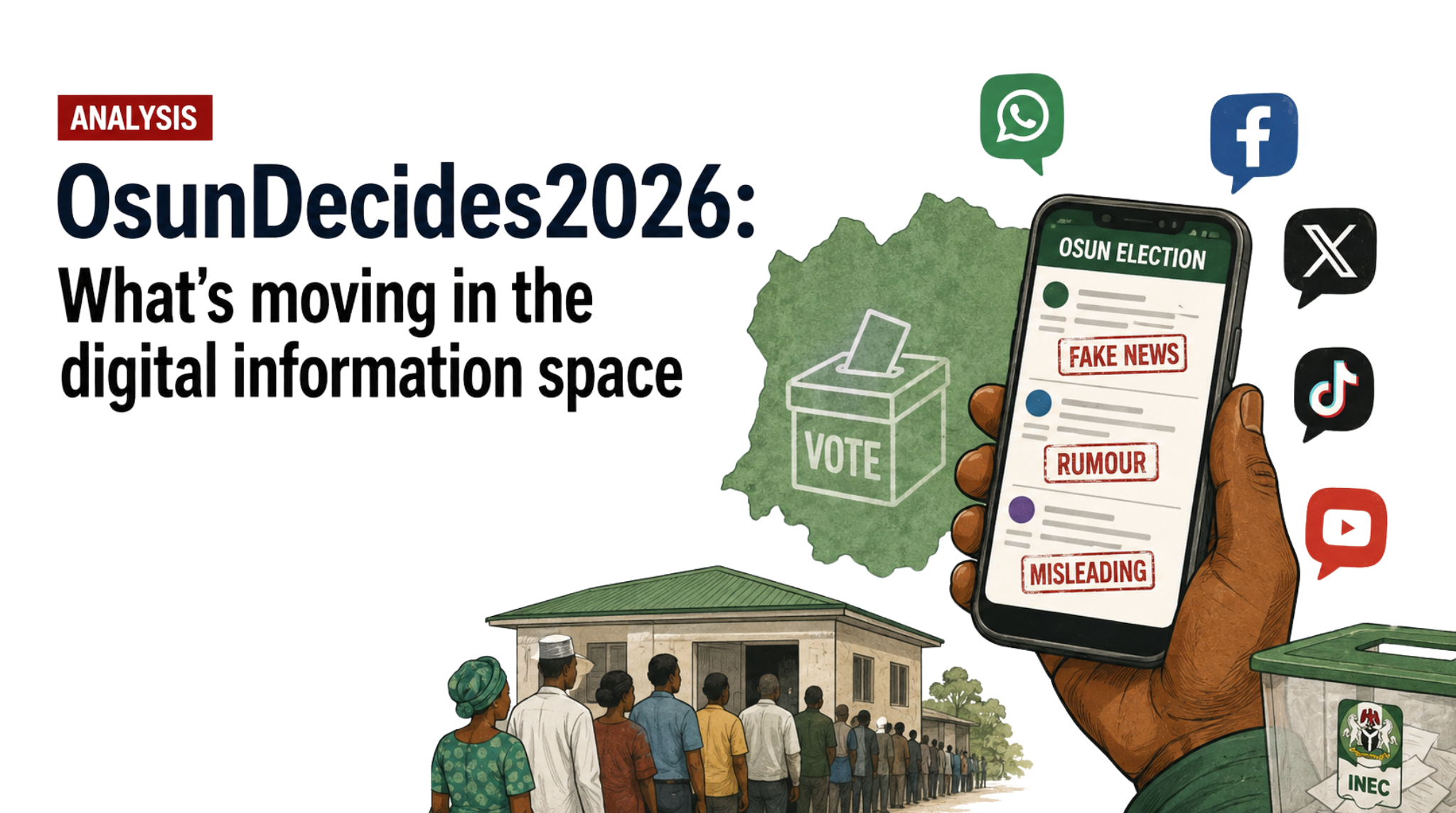
Osun voters go to the polls on 15 August with more than 2.3 million people on the register. But one of the most important battlegrounds is already active: the information space. Claims about government performance, election rigging, insecurity, candidates, and even the voting process itself are circulating on social media alongside ordinary campaign persuasion.
A politically interested audience, but with questions about trust
Osun accounted for 2,461 of the 4,169 young people surveyed by CJID across Osun and Ekiti, representing 59 per cent of respondents. The survey suggests a more complicated picture of youth political participation than simple apathy. Across the two states, 52.1 per cent of respondents said they were very or somewhat interested in politics, even though 54.3 per cent were not registered to vote.
There are also signs of a trust gap as more than half (56.8 per cent) felt their voices were not heard in political decision-making, while 40.4 per cent said they did not trust the electoral commission to conduct free and fair elections. Only 35.5 per cent said they did, with another 24 per cent undecided. These figures are not Osun-only estimates, so they should be interpreted with some caution. But with Osun respondents making up the majority of the sample, they provide useful context for this election.
The survey points to an interesting gap between political interest and participation among young people. This is worth considering alongside Osun’s electoral history. Voter turnout declined from 54.4 per cent in 2003 to 45.7 per cent in 2018 and 42.1 per cent in the 2022 governorship election, even as the number of registered voters increased. What might explain this gap? The survey offers some possible clues. More than half of respondents said they did not feel heard in political decision-making, while four in ten expressed little confidence in the electoral commission’s ability to conduct a free and fair election. In the context of the current Osun campaign, these perceptions become particularly relevant given the recurring claims around rigging, political violence and the possible use of state or federal power. The survey cannot tell us whether these concerns directly reduce participation. They do, however, raise useful questions about the relationship between political interest, institutional trust and the willingness of young people to participate in elections. For Osun, this may be worth watching as voting approaches.
Where young people get their political information
Social media was overwhelmingly the leading source of political information in the CJID survey: 3,080 respondents — 73.9 per cent — said they relied on digital platforms. X, Facebook, Instagram, TikTok, WhatsApp and YouTube now sit inside the political information chain. A rally speech can become a 30-second TikTok clip; an allegation can move from WhatsApp to Facebook and then into mainstream political debate; an old photograph can return with a new caption. That makes the health of the digital information environment an electoral issue in its own right. It is especially important because distrust and fear already affect participation. In the same survey, 44.6 per cent cited lack of trust in the political system as a barrier to participation and 42.3 per cent cited violence or intimidation.

What are we seeing?
1. The battle over performance
Much of the campaign is naturally a contest over records: jobs, teachers, roads, education, health, infrastructure and the economy. But performance claims are also fertile ground for misleading information because a number can be technically real and still give a distorted picture when its denominator, time period, funding source or comparison is missing. According to the Nigerian Democratic Report (NDR), disputes around teacher recruitment, alleged teacher dismissals and education costs have featured among the performance-related misinformation observed during the Osun campaign. This is why election fact-checking cannot stop at TRUE or FALSE. When a candidate promises thousands of jobs, for example, useful scrutiny asks how the jobs will be created, what they will cost, whether they are public or private-sector jobs, what institution will deliver them, and whether the state can sustain the recurrent expenditure.
2. Claims about the credibility and security of the election
Questions about the credibility of the election have also featured prominently in the campaign. Governor Ademola Adeleke has repeatedly accused the APC of planning to use “federal might” to influence the election. The APC has made similar accusations against the governor, arguing that the advantages of incumbency are being used against the opposition. These remain political allegations, and should be treated as such unless supported by evidence.
The claims are important to track because they are being made before voting has taken place. Repeated suggestions that the process may be compromised could affect how supporters interpret events on election day, particularly where there is already limited trust in electoral institutions.
Violence has also become part of this contest over the election narrative. APC and Accord have separately reported deaths among their supporters and blamed the opposing side. Independent monitoring has also recorded incidents of election-related violence in the state. The figures from political parties, however, should be distinguished from independently documented incidents, particularly where responsibility for individual attacks has not been established.
3. Security Rumours Can Suppress Participation
Security misinformation is potentially more consequential than ordinary campaign mudslinging because it can change behaviour. NDR documented false reports of bandit invasions in Inisa and Oyan, which were subsequently corrected by the police. A voter who believes a community or polling area is unsafe may simply stay home.
That danger sits beside Osun’s longer participation problem. Dataphyte’s historical review shows turnout declining from 54.42 per cent in 2003 to 45.74 per cent in 2018 and 42.09 per cent in 2022, even as voter registration expanded.
4. Confusion around candidates, parties and endorsements
Some of the misinformation around the election has focused on candidates, party decisions and endorsements. NDR, for example, documented a false claim that Iyiola Omisore had won the APC governorship primary.
Similar cases have appeared elsewhere. FactCheckHub found that genuine footage from a rally for Mr Oyebamiji was recirculated with a false caption presenting the crowd as protesters against President Tinubu. Africa Check also debunked a claim that the SDP had withdrawn from the election and endorsed Mr Oyebamiji.
These examples show how relatively simple forms of manipulation can create confusion. Genuine videos, letters or political events can be given a different context and circulated as something they are not. So far, some of the misinformation documented around the election has required little technical sophistication, even as concerns about AI-generated content and deepfakes continue to grow.
5. Economic concerns and campaign promises
Economic concerns feature strongly in CJID’s youth survey report. Unemployment was identified by 61.4 per cent of respondents, followed by security (44.3 per cent), education (42.2 per cent), corruption (41.2 per cent) and the rising cost of living (36.9 per cent). When asked what government should prioritise for young people, 77.2 per cent selected job creation.
This provides useful context for the prominence of jobs and economic promises in the campaign. It also makes the details of those promises important: how many jobs are being proposed, what kind of jobs, how they will be created, how much they will cost, and whether the state can sustain them.
What does this mean for trust and legitimacy of the electoral process?
In all, these narratives raise a broader question about trust in the electoral process. False security information can create fear around voting. Fabricated results can cause confusion during collation. Repeated allegations of rigging can create doubts about the process even before votes are cast, while misleading performance claims can affect how voters assess the choices before them.
The concern goes beyond election day. What people believe about the process can shape whether they accept the result. If competing political camps spend the period before an election telling their supporters that the process is likely to be manipulated, an unfavourable outcome can easily be interpreted through that same lens. Genuine procedural problems may reinforce those suspicions, but false or exaggerated claims can have a similar effect when they circulate widely enough.
This makes the period around voting and collation particularly important. Claims about BVAS failures, voter suppression, security incidents, result sheets, turnout figures and premature declarations can move quickly online, sometimes before electoral authorities or journalists are able to establish what actually happened. A misleading account of an isolated incident can also be presented as evidence of a statewide pattern.
There is a longer-term implication. The legitimacy of the eventual government will depend partly on whether enough citizens regard the process that produced it as credible. A winner may have the legal mandate to govern once the results are declared and any disputes are resolved, while still facing a political environment in which sections of the electorate question how that mandate was obtained. Where distrust becomes entrenched, it can shape reactions to the new administration long after the election itself has ended.
This is why the digital information environment in Osun matters beyond identifying individual false claims. The narratives circulating before, during and immediately after the election can become part of how the process is rememberedberedberedberedbered
Responding to election misinformation
Osun is not without a response. INEC has directly appealed to journalists to counter misinformation and separately warned that political tension is becoming difficult to sustain. The International Press Centre ran a fact-checking and digital-literacy workshop for INEC officials; civil-society groups coordinated a #CheckBeforeYouPost media campaign; PAACA and DigiAfricaLab convened a policy dialogue in Osogbo bringing together INEC, police, the National Orientation Agency, traditional and religious leaders and digital content creators. These interventions are important ahead of the election, but voting and collation will create a different information environment. Events will unfold quickly, often with incomplete information, creating room for false results, misleading security reports and premature claims of victory to spread before they can be verified.
Election-day monitoring and response
Election-day monitoring will extend beyond conventional election observation. CJID has deployed observers, analysts and fact-checkers across the 30 local government areas in Osun State, with an additional 40 experts operating from its Election Analysis Centre.
The monitoring will cover claims around voting procedures, BVAS and result transmission; premature declarations and fabricated result sheets; security incidents and rumours; manipulated images, audio and video; vote-buying allegations; misleading performance claims; impersonation and false endorsements; and signs of coordinated amplification.
An important part of this work will be assessing claims that may not fit neatly into true-or-false classifications. Some may contain accurate information but lack context, exaggerate the scale of an incident, or make broader conclusions that the available evidence does not support. Tracking these narratives alongside outright falsehoods provides a fuller picture of how information may shape perceptions of the election as it unfolds.
Discover more from Premium Times Nigeria
Subscribe to get the latest posts sent to your email.
