

*NMDPRA: Infrastructure, capital, data critical to price benchmark
*Lokpobiri: Deregulation has unlocked investment in Nigeria’s downstream
*Eyesan says rising refining capacity, oil output good for market integration
*Verheijen: Why refining capacity alone can’t guarantee energy security
*S&P advocates more liquidity to make regional benchmarks work
Emmanuel Addeh in Abuja
West African petroleum regulators Tuesday intensified efforts to establish an integrated regional refined petroleum products market capable of supporting credible pricing benchmarks and positioning the sub-region as a major fuel trading hub.
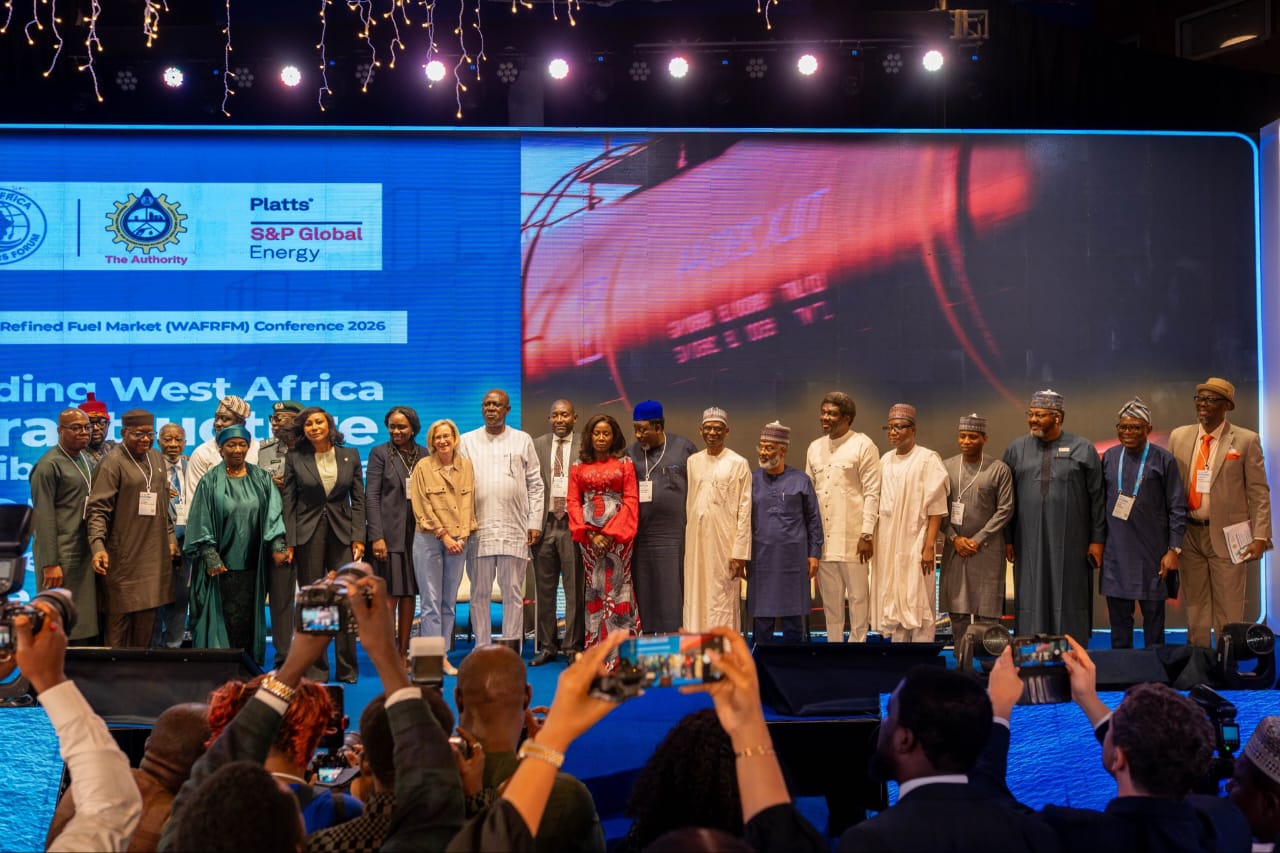
The push formed the central focus of the 2026 West African Refined Fuel Market (WAFRFM) Conference, organised by the West Africa Regulators Forum (WARF), the Nigerian Midstream and Downstream Petroleum Regulatory Authority (NMDPRA) and S&P Global Energy.
The conference, held under the theme: “Funding West Africa Infrastructure & Distribution to Create a Transparent Market for Regional Price Benchmarks,” brought together regulators, governments, refiners, traders, financial institutions, infrastructure investors and other industry stakeholders to deliberate on the development of the regional fuel market.
The discussions centred on the need to move beyond increased refining capacity to build the infrastructure, financing structures, regulatory systems, data architecture and market liquidity required to enable petroleum products to move efficiently across West Africa and allow prices to increasingly reflect regional market fundamentals.
Speaking at the conference, the Authority Chief Executive (ACE) of the NMDPRA, Mallam Umar Rabiu, said the region had made progress since the inaugural conference in 2025, but stressed that institutional developments must now be matched by investment and execution.
He said the 2025 conference had established a roadmap towards a West African refined products reference market, with emphasis on reliable refining capacity, stronger logistics and storage networks, interconnected ports, roads, rail and pipelines, harmonised standards, transparent market data and cross-border cooperation.
According to him, developments over the past year included the institutionalisation of regional regulatory cooperation through WARF, progress towards West African reference pricing and deeper collaboration with S&P Global Commodity Insights on market reporting and benchmark expertise.
However, Rabiu, who is the current chairman of WARF warned that a reference price alone could not create a trading hub.
“A reference price is not by itself a trading hub. A conference is not a market. Regulatory cooperation, important as it is, cannot substitute for the physical infrastructure, commercial liquidity, market information and operational excellence on which a credible trading hub must stand,” he said.
He identified infrastructure, capital, data and regulatory cooperation as critical foundations for creating a credible regional benchmark.
Rabiu pointed out that Africa has the resources, demand and increasingly the refining capacity, but needed to efficiently connect production to consumers through refineries, pipelines, storage terminals, jetties, ports, rail networks, roads, marine logistics, strategic reserves and digital trading platforms.
“The objective is not infrastructure for infrastructure’s sake. The objective is infrastructure that reduces the cost of moving energy, increases security of supply, improves inventory visibility, expands the number of credible market participants and creates the physical liquidity upon which transparent pricing depends,” he said.
Rabiu also urged investors to view the region’s infrastructure deficit as an opportunity, citing potential investments in pipelines, product transportation, storage, marine terminals, refinery expansion, road and rail logistics, gas infrastructure, digital commodity exchanges, product-tracking systems and integrated regional logistics corridors.
He noted, however, that capital would only flow into projects that were bankable, with predictable regulation, understood risks and sustainable returns. The NMDPRA chief also stressed the importance of operational efficiency, warning that infrastructure without operational excellence could create expensive bottlenecks.
“Our ports must become more efficient. Our terminals must improve turnaround times. Our pipelines and storage systems must operate safely and reliably. Our refineries must pursue sustained utilisation, reliability and competitive yields,” he said.
He further called for improved data transparency, noting that credible price discovery required sufficient transactions, willing participants, reliable reporting and confidence that market information reflected actual commercial activity. “Markets operate on information. Benchmarks operate on trust,” he said.
Also speaking, the Minister of State, Petroleum Resources (Oil), Senator Heineken Lokpobiri, said Nigeria’s deregulation of the midstream and downstream petroleum sectors had created renewed investor interest and opened opportunities for greater regional integration.
According to him, the federal government took a bold decision to completely deregulate the downstream sector, creating an environment capable of attracting investment and unlocking the potential of the industry.
“Before this government came, nobody had the courage to turn around the downstream. Not even the military leaders had the courage. But at the breaking point, he (President Bola Tinubu) took the boldest decision of completely deregulating.
“Today, the midstream and downstream are completely deregulated. That is why we are seeing renewed interest,” Lokpobiri emphasised.
The minister said Nigeria must look beyond its domestic market and position itself to serve the wider West African market, arguing that the region could benefit from the country’s growing refining capacity.
He stressed the importance of processing resources locally rather than exporting raw materials and subsequently importing refined products at significantly higher costs.
“We export our raw cashews. We export our raw agro-products outside. They refine them. We process them. And we buy them back ten times the price,” he said.
Lokpobiri said Nigeria should use its growing refining capacity to capture a larger share of the West African market, but noted that this would require a sustainable pricing mechanism and stronger collaboration among countries and regulators.
For her part, the Chief Executive of the Nigerian Upstream Petroleum Regulatory Commission (NUPRC), Oritsemeyiwa Eyesan, said developments across Nigeria’s oil and gas value chain were creating an opportunity for deeper regional market integration.
Eyesan pointed to the increase in refining capacity, rising crude oil production and improvements in the gas sector as evidence of significant changes in the Nigerian petroleum industry.
“We are seeing a spike in refining capacity. We are seeing Nigeria not only meet its refining needs, but attempt to also export. That is unprecedented,” she said.
She added that Nigeria’s gas industry was moving from a position of total deficit towards bridging the supply gap, while crude oil production had also increased. “We are now able to cross the barrier that OPEC has set for us. That, again, is unprecedented,” she said.
Eyesan explained that the next step was to close the loop by integrating West African petroleum markets, stressing that countries could no longer afford to operate in silos. “The West African market must be integrated. We can no longer afford to operate in silos,” she pointed out.
She called for integrated regulatory systems and appropriate infrastructure across the value chain, arguing that the region needed to build ready markets and systems that connected rather than isolated individual countries and industries.
Also speaking, the Special Adviser on Energy to the President, Olu Verheijen, said West Africa’s challenge was no longer primarily a question of resources or refining capacity, but whether the region could develop the systems required to efficiently move energy from where it is produced to where it is needed. “Refining capacity alone, as big as ours is, does not create energy security,” she said.
Verheijen said refined products could only deliver economic value when they could be financed, stored, transported and distributed reliably.
“A refined product only delivers economic value when it can be financed, stored, transported, and distributed reliably. Without infrastructure, supply remains stranded. Without transparent pricing, investors price uncertainty rather than opportunity,” she said.
She said the region needed pipelines, ports, storage facilities, coastal vessels, trucking networks and trading platforms, as well as greater access to trade and infrastructure finance.
Verheijen said Nigeria was increasingly refining the majority of the petrol consumed domestically, with imports falling significantly, while refined products were increasingly reaching markets outside the country.
She said the next phase should focus on connecting the growing supply with regional demand through infrastructure and transparent markets.
Head of Platts, S&P Global Energy, Vera Bleu, in her intervention, said significant progress had been made towards developing regional price references over the past year, but stressed that market participants themselves must create the liquidity required to make regional benchmarks credible.
She said S&P Global had expanded its regional pricing assessments, including more frequent updates for petrol and other refined products in response to increased market volatility.
“We can give the foundations, we can make the reference prices available. It’s time for everybody in this room to take bold steps to really bring them alive,” she said.
Bleu said the challenge was that market participants would naturally continue to gravitate towards established international benchmarks because of their liquidity.
“The reality is you will have to create them. We can give the foundations, we can make the reference prices available. It’s time for everybody in this room to take bold steps to really bring them alive,” she said.
Deputy Governor, Operations, Central Bank of Nigeria (CBN), Emem Usoro, said a well-functioning and well-priced refined products market could create significant opportunities for the financial sector, particularly in mobilising long-term capital for refining, storage, transportation and other critical infrastructure.
She pointed out that such developments could strengthen capital markets, improve foreign exchange efficiency, boost intra-African trade and enhance investor confidence across the region.
