

This dramatised trial takes Henrik Ibsen’s 1882 play about a man’s campaign to expose the secret scandal of contaminated water in his town and turns it into a modern day interrogation: of speaking out versus remaining silent, of a family at war and of fiction and reality itself.
In fact, is this a drama at all? It starts off as such but minutes later, the celebrated Brazilian screen actor Wagner Moura, playing Ibsen’s Thomas Stockmann, seemingly breaks character to talk to us directly. Stockmann still sits invisibly on stage and we as an audience are here to judge him, he says, before returning to inhabit him.
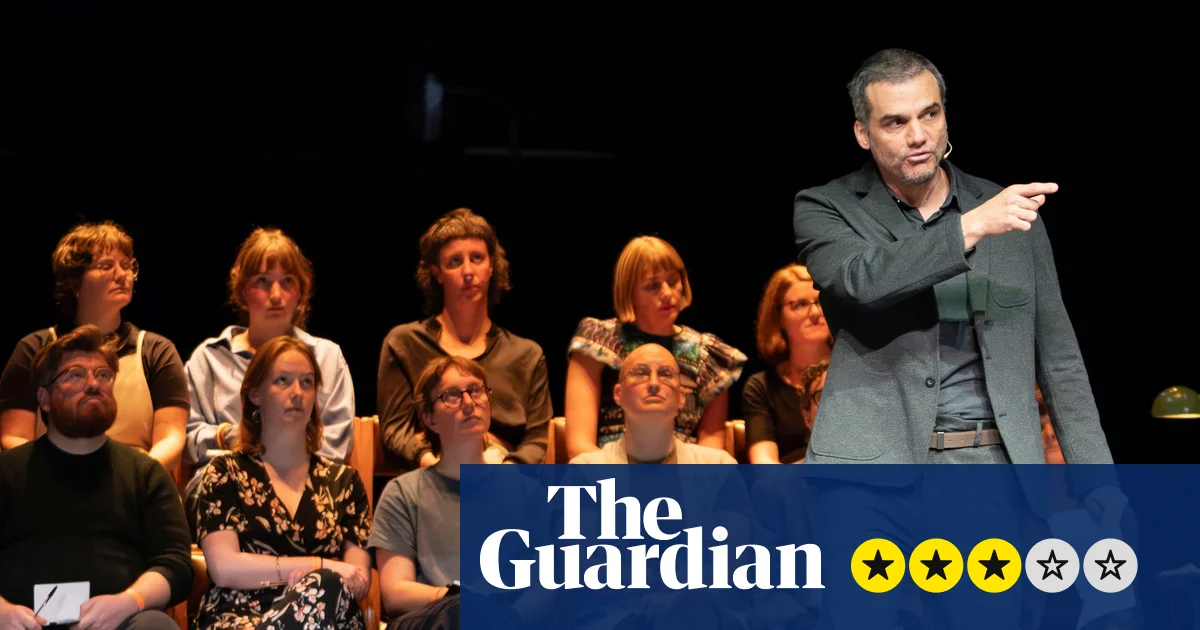
So Stockmann’s trial begins. Here he is: a family man living in contemporary Brazil, in a spa town whose tourism is dependent on the water that he insists is poisoning people. Is he a heroic truth-teller, belligerent anti-hero or self-serving villain? A 12-strong jury made up of audience members (have actors infiltrated this lineup? We don’t know, it is all uncertain ground) are called to sit on stage for most of the play before leaving to deliberate their verdict.
Christiane Jatahy, who has conceived the show and written it with Moura and Lucas Paraizo, knows how to reinvent a classic. Often using post-dramatic techniques and incorporating screens on stage, she has repurposed the works of Anton Chekhov and August Strindberg, and three years ago brought Dusk, her documentary-style adaptation of Lars von Trier’s film Dogville, to the Edinburgh international festival.
A blend of documentary and drama forms, it dismantles the fourth wall, at times, in a similar vein to Thomas Ostermeier’s version of the play, staged in London two years ago. But this is more radical in its ambitions. Its central scandal certainly chimes in our world, too – as shown in the recent docudrama Dirty Business – but also resonates with the “forever chemicals” investigations in the US. Jatahy has taken an old story and turned it into a tale of our time.
Despite this resonance, there is just not enough force in the moral debate at the heart of this production. The question of whether Thomas was right to reveal the truth is a foregone conclusion, with not enough to mitigate it. That his truth-telling affects the town’s tourism seems like an inadequate argument in the face of mass water poisoning. You wish for greater complexity or more skin in the game.
Still, it is gripping and original. Moura is an immensely charismatic force on stage, at ease with his fissured role – as Thomas and an observing commentator of Thomas. Everyone around him gives powerful performances, too. There are two young sons off stage and a wife who has died – partly, it is implied, from the stress of Thomas’s campaigning. We see these characters on screen, in videos that bring grief and betrayal to the storyline. His daughter Petra (Julia Bernat) sits on stage with him, presenting evidence and conducting cross-examinations opposite his brother, Peter (Danilo Grangheia), who is Thomas’s most vocal adversary. They bring raised passions, fights and tears. Ultimately, it is this traditional element, of turbulent family drama, that grips the most.
At the Lyceum theatre, Edinburgh, until 10 August
