

Stay informed with free updates
Simply sign up to the Travel & leisure industry myFT Digest — delivered directly to your inbox.
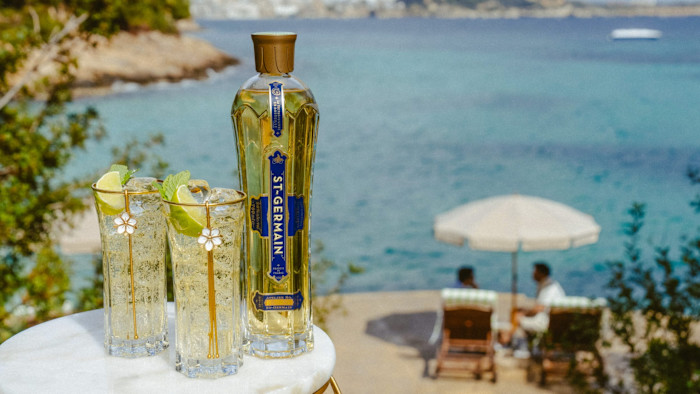
Sales of Bacardi’s St-Germain liqueur are growing faster than Campari’s Aperol this summer as the “Hugo” elderflower spritz trend takes hold in the US, challenging the Italian group’s dominance of the aperitif market.
Demand for the elderflower liqueur in the US soared 40 per cent in the past three months as spritz drinkers switched away from the lurid orange Aperol, which fell 4 per cent in the same period, according to NielsenIQ.
Ed Mundy, analyst at Jefferies, said that until the group got Aperol sales growth accelerating once more, he would not upgrade the stock from its current “hold” recommendation. Aperol makes up more than a quarter of Campari’s group sales.
Campari has outperformed spirits rivals such as Diageo over the past three years thanks to its supremacy in the aperitif category. Campari, Aperol and the Italian group’s hot pink Sarti Rosa have flown off the shelves thanks to their use in spritz cocktails, popular for their Instagram-friendly bright colours and lower alcohol content.
Companies eyeing Campari’s success have been trying to gatecrash the aperitivo hour. Bacardi first saw potential for its St-Germain brand, which was previously a specialist bartender ingredient, to become the base for a spritz five years ago.
Ned Duggan, chief marketing officer at Bermuda-based Bacardi, said the Hugo spritz, which originates from the Italian Alps, took off in the US because of the uptick in Americans travelling to Europe after the Covid-19 pandemic.
“European travel picked up and this is a cocktail that people discovered,” Duggan said. “They were talking about it on social media or bringing it back and talking to their friends.”
Despite its rapid growth, sales of St-Germain are still dwarfed by Aperol. Campari sold 8.8mn cases of Aperol globally in 2025, compared with Bacardi’s 435,000 cases of St-Germain, according to Jefferies.
Family-owned Bacardi, which also makes Bombay Sapphire gin and Grey Goose Vodka, and Campari each hold roughly 2-3 per cent of the highly fragmented global spirits market.

Campari’s chief executive Simon Hunt batted away concerns that the St-Germain spritz represented a material challenge.
“I don’t think it’s much of a battle, put it that way,” Hunt said.
He argued that Campari was well positioned thanks to a portfolio of aperitifs that catered to all tastes, from bitter to sweet. A Hugo spritz was unbranded, he added, unlike an Aperol spritz, which meant Bacardi had to work harder to have its St-Germain brand associated with the cocktail.
“We see it as an opportunity . . . If someone’s going to help build the category, fantastic.” Campari has poured investment into marketing Aperol to US drinkers this year, deploying 21 brand ambassadors across 11 states.
The British executive said there was enormous growth potential for the category, noting that spritz penetration in the UK was 3 per cent of the market compared with 1 per cent in the US.
Two-thirds of the growth in spritz consumption comes from consumers switching from beer, with the final third switching from wine, according to Jefferies.
On Wednesday Milan-listed Campari reported that Aperol sales grew 3.3 per cent in the first half of the year, a material slowdown from historic peaks.
The company raised its profit outlook on Wednesday thanks to the refunding of US tariffs imposed on European spirits imports.
