

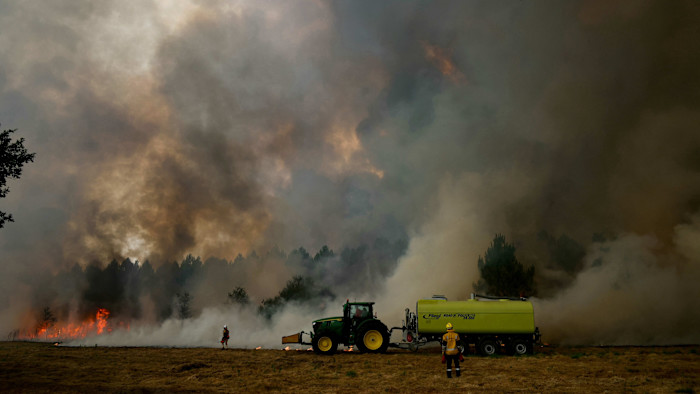
Wildfires burning near Bordeaux have put some of France’s most famous winemakers on edge, as shifting winds threaten to push flames or smoke towards vineyards just weeks before harvest.
At Château Malartic-Lagravière, which has been producing grand cru reds for more than two centuries, growers are scrutinising the winds and climbing temperatures. The domaine, just south of Bordeaux, is only 10km from areas evacuated because of fire risk.
“There is talk of zombie fires that keep coming back to life,” said Séverine Bonnie, who works at the château that produces reds and whites with the Pessac-Léognan appellation. “The situation remains fragile so we are on edge.”
Authorities said on Thursday that the fire in Gironde, the south-western region where Bordeaux’s winemakers are clustered, was no longer expanding. Some 80,000 people who had been evacuated were authorised to return home.
But firefighters were still battling breakouts, with officials saying the next 48 hours would be critical to containing the blazes after crews dug 127km of trenches and doused areas with fire retardant.
Wildfires have become a growing threat to French winemakers in recent years, adding to the strains from climate change and rising temperatures, including shorter growing seasons, lower yields and changes to the taste and quality of grapes.
The worst has already happened for some growers in Provence near the Mediterranean coast where a smaller wildfire broke out earlier this month.
In Roussillon, the fire burnt nearly all of Gilles Troullier’s 9-hectare vineyard. Among the vines lost were 30-year-old Carignan, a variety particularly suited to the Mediterranean climate that produces increasingly refined wine as it ages.
“It’s an irreplaceable wine-growing heritage that has burnt,” he said. “We are at the forefront of this phenomenon of climate change, with semi-desertification in this region.”
For wine producers, the danger is not only that fires destroy vines. Smoke from burning wood can damage grapes from afar, as volatile phenols are absorbed through their skin and later release smoky or ashy flavours during fermentation and ageing.
“A wine that initially may not smell of smoke can gradually develop chimney-like odours as it ferments, or even during ageing,” said Eric Serrano, a director at France’s Vine and Wine Institute, a research body. “It is a time bomb.”
Some 115,000 hectares have burned in France this summer, putting it on course for the worst wildfire season since 1949, when a blaze in the Landes forest destroyed 130,000 hectares and killed more than 80 people. Repeated heatwaves and low rainfall have left fires able to spread rapidly.
For now, the Gironde wildfires remain far enough from many of Bordeaux’s best-known vineyards, including the Médoc appellations of Margaux and Saint-Julien along the Gironde estuary and Saint-Émilion east of the city, that they do not pose an imminent threat. Pessac-Léognan and Graves, closer to the flames and smoke, would be the first affected.
If firefighters cannot prevent the blazes from moving north or east, such trajectories could put more vineyards at risk. Plus, the longer the week-long crisis drags on, the more tourism revenue could be lost as people cancel reservations and visits.

Winemakers’ worst fears did not materialise after another series of fires broke out in the Gironde in 2022, burning more than 20,000 hectares of forest. Tests subsequently found negligible levels of smoke compounds in most grapes and widespread smoke taint was not detected.
In California’s Napa Valley, however, many wineries chose not to release a 2020 vintage because the risk of smoke damage to quality and reputation was considered too high.
In Provence, winemaker Lucie Moutonnet said flames had ripped through 14 of 18 hectares at Domaine de la Mercadine, leaving her about a month before harvest to test burnt parcels and grapes exposed to smoke and ash.
“If these compounds are present, I will decide not to harvest,” she said, adding that yields could be divided by three.

In Bordeaux, the wildfires come after years of weak demand for red wine in France and abroad have pushed producers to uproot vineyards. About 21,000 hectares were removed in Gironde between August 2023 and May 2026 through subsidised and unsupported schemes aimed at cutting production and rebalancing the market.
Even prestigious wines have not escaped the downturn. The Bordeaux fine-wine market has lost nearly a fifth of its value over the past five years, according to the Liv-ex Bordeaux 500 index.
Hotter summers could add to the pressure on Bordeaux, where most wine produced is red. Sales of red wine typically fall during warmer weather as drinkers turn to chilled whites, rosés and sparkling wines.
But the region’s white wines face their own climate risks. Adeline Divot of Château Guiraud said the Landes forest helped keep the Ciron river cool. When it meets the warmer Garonne, the difference in temperature creates autumn morning fogs that encourage the growth of Botrytis cinerea, or “noble rot”, which concentrates the grapes and gives Sauternes its distinctive flavours.
“Our appellation exists thanks to this forest,” she said. “It is very precious, and seeing it up in flames worries us.”
Cartography by Steven Bernard
