

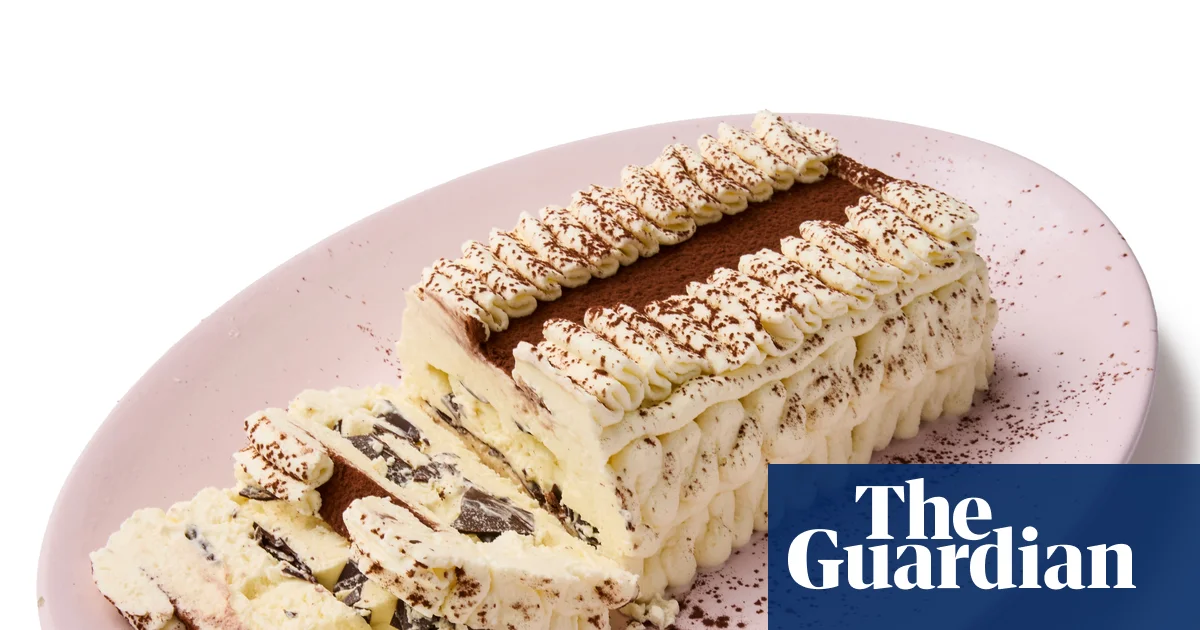
When I was growing up, viennetta was something I had in other people’s houses – for some reason, my mum regarded these frilly blocks of ice-cream as a waste of money, which made them all the bigger treat on the rare occasion I did get a front-row seat at the cracking of the chocolate. Launched, like me, in 1982, when developers at Wall’s realised that pumping ice-cream on to the production line slightly faster than the speed of the conveyor belt created a concertina effect that, I think we can now, with the wisdom of age, agree, is more impressive to behold than to consume. No doubt diehard devotees will beg to differ, but even as a child I couldn’t help but notice that all that air made the viennetta distinctly light on flavour (no wonder one slice is never enough, as the old advertising campaign had it). Happily, you can recreate the magic at home with something that looks good and tastes great – and you don’t even need your own conveyor belt!
The ice-cream
You may be relieved to learn that this is not a recipe for which you’ll need an ice-cream maker – the real thing is an egg-free zone, though two of the recipes I try do use them. For Richard, Oliver and Gregory Gladwin of Notting Hill’s The Shed, that’s in the form of yolks, which are whipped with sugar syrup to make a pâte à bombe, which is then folded into whipped cream to produce something much like a frozen vanilla mousse. Delicious, but distinctly richer and denser than the authentic model. Pastry chef and award-winning author Nicola Lamb, however, who has trodden this particular obsessive path before me, and whose findings, published on her reliably excellent Kitchen Projects Substack, I am indebted to, whisks a French (ie, uncooked) meringue into cream instead, with the aim of achieving maximum airiness without any other trace of the eggs themselves, because egg whites are “pretty much flavourless and colourless”.
Her version is judged by my testers to be the closest to the original, but with a superior richness of flavour, rather than texture – it’s definitely lighter than Gabriella English’s condensed milk version in Red magazine, which is wonderfully creamy, but has the solidity of an old-fashioned brick of vanilla, or Georgina Hayden’s whipped cream and mascarpone number in her new book MEDesque, which is positively velvety … unlike the OG. I’m also very keen on the slightly smoother version from the much-missed Delicious magazine, which combines whipping cream with glucose syrup and ice-cream, but, seeing as glucose syrup, which also features in the Wall’s version, is strictly speaking a UPF, I’ve decided to stick with the egg whites, which have the additional benefit of being easier to source in even the smallest of shops.
“With double cream,” Lamb says, “we know that you need only 10-25% sugar to cream [by] weight to make a smooth and not-too-sweet final product. So, although it is tempting to add extra sugar to make a super-stiff meringue, we then have a potential issue of the dessert being over sweet.” I hold up my hands to our collective unsophisticated palate – my testing panel all wistfully say they wish it was a bit sweeter – so, though the credit must go to Lamb, I’ve tweaked the ratios.
The chocolate
The other signature characteristic of the actual Viennetta is its layers of crackly chocolate, which shatter satisfyingly under the knife. To get them to do this, they have to remain distinct from the ice-cream, and the recipes I try take a variety of approaches to this. Delicious magazine, English and Hayden all melt the chocolate, then add it in liquid form, though only the latter two advise leaving it to cool first, which is vital: molten chocolate has an inconvenient tendency to melt into whipped cream. Hayden drizzles it, which I find results in a somewhat patchy layer, English spreads it (which is impossible to do without some mixing of the cream and chocolate), while Delicious suggests piping or spraying it.
Best I draw a line over my inept attempts to get molten chocolate through a spray bottle – suffice to say there was a fair bit of cleaning up to do afterwards – but having tried all these approaches, I would strongly recommend melting the chocolate in advance, then spreading it out into a thin layer that, once solid, can simply be slotted in between the layers of cream, as Lamb and the Gladwins do. You don’t need the marble slab the Gladwins mention for this purpose; in fact, I found it much easier on Lamb’s baking paper-lined tray than the clingfilm the brothers give as an alternative.
You don’t even need to break the chocolate neatly – shards will do, though you might, as Lamb does, like to finish with a large piece on top. It doesn’t feature in the boxed sort, but it does snap very nicely.
The flavouring
Wall’s Viennettas come in a reassuringly modest range of flavours – as well as the classic vanilla and chocolate, there’s a mint version (always my own favourite) and a salted caramel one that I haven’t yet tried, plus a few seasonal specials – but one of the great things about making your own is that you can make your childish dreams come true at the same time. Most of the recipes I try stick with vanilla (extract, paste or seeds, as you like, though the tell-tale black flecks of fresh seeds is always a suggestion of quality. I say “fresh”, because some commercial vanilla ice-creams get their speckles from “exhausted vanilla bean pieces”, which look good, but taste of very little). The Gladwins include a layer of homemade butterscotch sauce, English some little crunchy pieces of hazelnut, which remind us all pleasantly of another iconic Wall’s produce, the Cornetto, while Hayden goes brilliantly rogue by whizzing up basil leaves to create something that looks like a mint viennetta, but that has the sweet, anise-like, Mediterranean perfume of basil. I’ve stuck with the classic version, but I already have plans to get more adventurous: perhaps a fig leaf and almond caramel is in my future?
The construction
An ice-cream terrine is always a beautiful thing to eat, but, without suitable adornment, it can risk looking rather brick-like. Delicious pipes the mixture in pretty layers using a star-shaped nozzle, allowing each one to freeze before adding the next, which works well, but is an undeniable faff. A better solution, as far as I’m concerned, is to freeze the whole thing in a loaf tin, as everyone else recommends, then decorate it with sweetened whipped cream, as Lamb suggests (at this rate, her name should possibly be at the top of this column rather than mine). I’ve gone for whipping cream for this outer layer, to make it a little lighter, but if you’ve got double leftover from the ice-cream, feel free to use that instead, or go for a combination.
The top of the real deal is simply sprinkled with cocoa powder, but, depending how faithful you’d like to be to the original, you might like to add another layer of chocolate, some chopped nuts or perhaps (and I am very pro this idea) some cherries in syrup in a nod to another 1980s favourite, the black forest gateau.
Once refrozen, this dessert should keep well in the freezer for up to a month.
Perfect homemade viennetta
Prep 15 min
Freeze 3 hr 30 min +
Cook 5 min
Serves 6
70g dark chocolate
Flaky salt (optional)
300g double cream
3 medium egg whites
1 pinch salt
Seeds of 1 vanilla pod, or 1 tbsp vanilla bean paste or extract
70g caster sugar
To decorate
200g whipping or double cream
40g caster sugar
Cocoa powder, to dust
Break the chocolate into pieces, then melt it in a heatproof bowl set over, but not touching, a pan of simmering water, or in the microwave. Meanwhile, line a baking tray with greaseproof paper, and stick the paper down at the corners with a little honey or jam.
Pour the melted chocolate on to the paper, spread it out as thinly as possible, then sprinkle with a little flaky salt, if using, and leave to set. Once set, break the chocolate sheet into shards.
Line a roughly 19cm x 9cm x 6cm loaf tin (that is, a 450g or 1lb tin) with clingfilm, leaving enough overhang to fold over the top later (you may need to use two pieces of clingfilm set at right angles).
Whip the cream for the ice-cream in a large bowl or food mixer until it just holds soft peaks, bearing in mind that you’ll be whipping it further in a minute.
Whisk the egg whites (you should have about 105g) and a pinch of salt in a second bowl, until foamy, then beat in the vanilla. Gradually, and still whisking at a moderate speed, add the sugar and beat to soft peaks.
Add a spoonful of this meringue mix to the cream, whisk briefly to combine, then carefully fold in the remaining meringue until it’s thoroughly incorporated, and keeping as much air in the mixture as possible; don’t worry if it looks a little grainy.
Spoon a third of the cream mixture into the lined tin and gently level the top (again, you don’t want to knock out the air), then scatter with half the chocolate shards.
Repeat with another layer of cream and another layer of chocolate, then top with a final layer of cream. Fold the clingfilm over the top and freeze for at least three hours, until solid.
Whisk the whipping or double cream with the caster sugar until it holds its shape, then spoon into a piping bag and cut a ½cm hole off the tip.
Lift the viennetta out of its tin and unwrap, then decorate the sides with alternating straight and frilly lines of whipped cream. If you’re feeling fancy, use a ribbon nozzle to decorate the top with wiggly parallel lines, or simply repeat the same pattern on top.
Return to the freezer for at least half an hour, until frozen. Sprinkle with cocoa powder before serving – a line down the centre looks authentic.
-
Viennetta: is it still the fanciest dessert you can imagine, or have you grown out of this distinctly ultra-processed, if undeniably enjoyable treat? What’s your favourite memory of them, your favourite flavour, and what will you be putting in your homemade version?
