

MOHAMMED KARI contends that Nigeria should make production more rewarding than importation
In the past few weeks, I have watched the debate over the Dangote Refinery and fuel import licences from the sidelines. Every other day, I see a different headline about ships arriving with imported petrol, fertilizer, and countless other products. And that has left me asking a simple but troubling question: what exactly do we still produce for ourselves? Besides, at a time when a Nigerian investor has committed about US$20 billion to solving a problem government failed to solve for decades, why are we still debating how to preserve an import-dependent system?
For me, the real issue is not about Dangote. It is about Nigeria. It is about whether we want to remain a nation that consumes what others produce or become a nation that produces what it consumes. Indeed, nothing illustrates Nigeria’s economic dilemma better than the story of its government-owned refineries. In recent decades, billions of dollars have been spent on refineries in Port Harcourt, Warri, and Kaduna. Yet they have consistently failed to meet domestic fuel demand. Available statistics indicate that more than N11.35 trillion has reportedly been spent on maintenance and rehabilitation, while refinery performance remained poor.
If we do a rough arithmetic for an exchange rate of about N500 to an American dollar, (the prevailing exchange rate before this government came to power in 2023), that amounts to about US$22.7 billion. That’s more than the estimated cost of the Dangote Refinery itself! In effect, Nigeria has spent more money trying to rehabilitate ageing refineries than to finance a brand-new world-scale refinery. The result is a painful contradiction: Nigeria is one of the world’s largest crude oil producers while importing much of the petrol it consumed. We were exporting crude, paying others to refine it, and then using scarce foreign exchange to buy it back. It was against this backdrop that the Dangote refinery emerged.
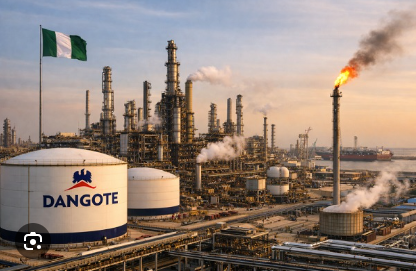
Meanwhile, Aliko Dangote’s significance lies not merely in his wealth but in his decision to invest in production rather than importation. His investments in cement, sugar and fertilizer have helped Nigeria move closer to self-sufficiency, created jobs, expanded industrial capacity, and opened export opportunities. These investments retain value within the Nigerian economy instead of exporting that value abroad. With a capacity of about 650,000 barrels per day, Dangote Refinery is the largest expression of this industrial philosophy.
For decades, foreign economies captured much of the value from refining Nigerian crude oil. The Dangote Refinery seeks to reverse that pattern by ensuring that more of the petroleum value chain remains in Nigeria. This is therefore about far more than fuel. It is about jobs, industrial capability, economic sovereignty, and national self-sufficiency. By refining the crude that we export locally, more value remains within the country, supporting jobs, taxes, suppliers, and domestic businesses. Reduced import dependence also means less pressure on foreign exchange reserves and fewer dollars leaving the economy.
The Dangote Refinery is an example of import substitution: producing locally what was previously imported. It is trite to say that domestic production creates jobs, develops skills, strengthens supply chains, increases tax revenues, and expands economic output. Once local demand is met, surplus production can be exported to earn foreign exchange. This is how successful economies develop. They produce, add value, and export.
Critics argue that Dangote’s growing influence could reduce competition. Yes, competition is important. But the real question is what kind of competition Nigeria should encourage. There is a difference between investors competing by building refineries and competing by importing products made elsewhere. One expands productive capacity; the other largely distributes what others have produced.
The answer to industrial dominance should be more production, not more dependence. No country has industrialized by preferring imports to local production when it has the ability to produce for itself. If foreign interests oppose Nigerian self-sufficiency, their motives are understandable. They benefit from Nigeria remaining a market for their products. The more important question is why some Nigerian local interests appear comfortable defending an economic model that has left Nigeria dependent for decades.
The government, too, cannot afford to be indifferent. Every successful industrial nation deliberately supported domestic production, value addition, and strategic industries. If a Nigerian investor commits US$20 billion to solving a national problem that governments failed to solve for decades, the least one should expect is a policy environment that encourages production and rewards productive investment.
The real question is not whether Nigerians should compete with Dangote. It is how they should compete. Nigeria should make production more rewarding than importation. This requires a clear industrialization policy, incentives for manufacturers and productive investors, stable regulations and predictable policies, better infrastructure, power, transportation, and logistics and more refineries, factories, and processing plants. The solution to dependence is production, not more dependence.
One critical stakeholder is often overlooked in this debate: the consumer. Businesses organize. Importers organize. Lobbyists organize. Yet consumers, despite their enormous collective power, often remain passive. Every purchase is an economic vote. Every naira spent helps determine which businesses grow and which economic model succeeds. The larger issue is therefore not whether Nigerians should support Aliko Dangote as an individual. The real question is whether Nigerians should support industrialization, productive investment, and national transformation.
The question before Nigeria is no longer whether we can industrialize. A Nigerian has already invested about US$20 billion to prove that we can. And let us be clear: whatever happens, Dangote is unlikely to be the loser. His products can find markets across Africa and around the world. The real loser, if we choose wrongly, will be Nigeria and Nigerians.
What we must also understand is that consumers are far more powerful than they often realize. When they act together, they can influence markets, determine government policy and shape corporate behaviour. Organizing does not require protests or confrontation. It begins with informed choices: supporting businesses that manufacture locally, create jobs, invest in production, and retain value within Nigeria. Professional associations, labour unions, student bodies, community organizations, and civil society groups can help amplify that message and promote a culture that celebrates production over dependency.
The choice before Nigeria is simple: continue importing prosperity from others or begin creating it for ourselves. History will remember which path we chose.
· Kari, former Commissioner for Insurance/CEO, National Insurance Commission (NAICOM) is the Wazirin Bauchi
