

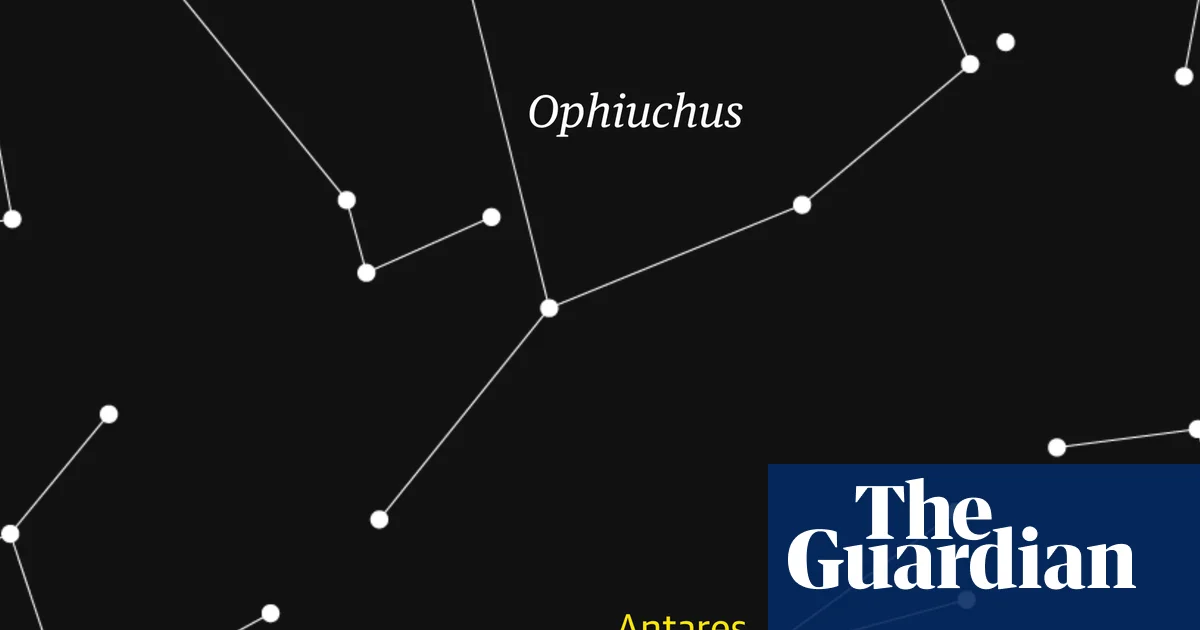
This week we will take the opportunity to identify Scorpius, the Scorpion, one of the famous zodiacal constellations.
In mythology, Scorpius is the creature sent to kill Orion, the hunter. The two constellations are therefore on opposite sides of the sky from one another, so that when Scorpius rises, Orion has already departed.
The full constellation is visible from more southerly latitudes, but for stargazers in the UK it can be one of the more frustrating to track down because it is so low that it never fully rises above the horizon. The chart shows the view looking low in the southern sky from London at 11pm BST on 24 July. The constellation remains in roughly the same part of the sky all week, but on this night the moon also graces the scene.
The bright waxing gibbous moon lies close to Antares, the red-orange star that marks the heart of the Scorpion. Its colour can be striking, appearing ruby jewel-like, although from Britain it often appears to twinkle because it is seen through the thicker, more turbulent air close to the horizon.
Antares means “rival of Mars”, a reference to its reddish colour. In reality it is a red supergiant star, vastly larger than the sun and nearing the end of its life.
