

James Cameron loves tough female characters. That seems like a given now, after three Avatars and two particularly muscular arms belonging to Linda Hamilton in Terminator 2. Even the lushly romantic Titanic is about a supportive, sweet-natured boyfriend lending his love the extra smidge of strength she needs to live a rich and iconoclastic life without him, until she’s freely chucking diamonds into the sea at 100 years of age. But in Cameron’s 1984 de facto feature debut The Terminator (after a Piranha sequel that he attempted to disown), T2’s Hamilton is stalked and appropriately terrified by Arnold Schwarzenegger’s slasher-like killer robot. She’s a great character who gets majorly pumped up for the sequel in 1991. By then, Cameron had plenty of practice: he had already written and directed Aliens, maybe the best pumped-up sequel ever made, which turns 40 this week.
Ellen Ripley, introduced as the warrant officer onboard the ship Nostromo in Ridley Scott’s 1979 sci-fi horror picture Alien, is already a great character by the end of that film. But while the anecdote about James Cameron pitching a sequel by appending a dollar-sign to Alien’s title, concisely showing what a simple pluralization could do, has perhaps overtaken the buffing up of Ellen Ripley in the most-circulated lore about this movie, she’s really the first subject of Cameron’s great plussing. Without betraying the simplicity and resilience of her character in the first film, Cameron reintroduced Ripley as a survivor, landing on Earth almost 60 years after the events of the earlier film. (In a deleted scene restored in the film’s longer special edition, Ripley even learns that her daughter has died in the interim – as an adult, given that Ripley was in cryosleep for decades.)
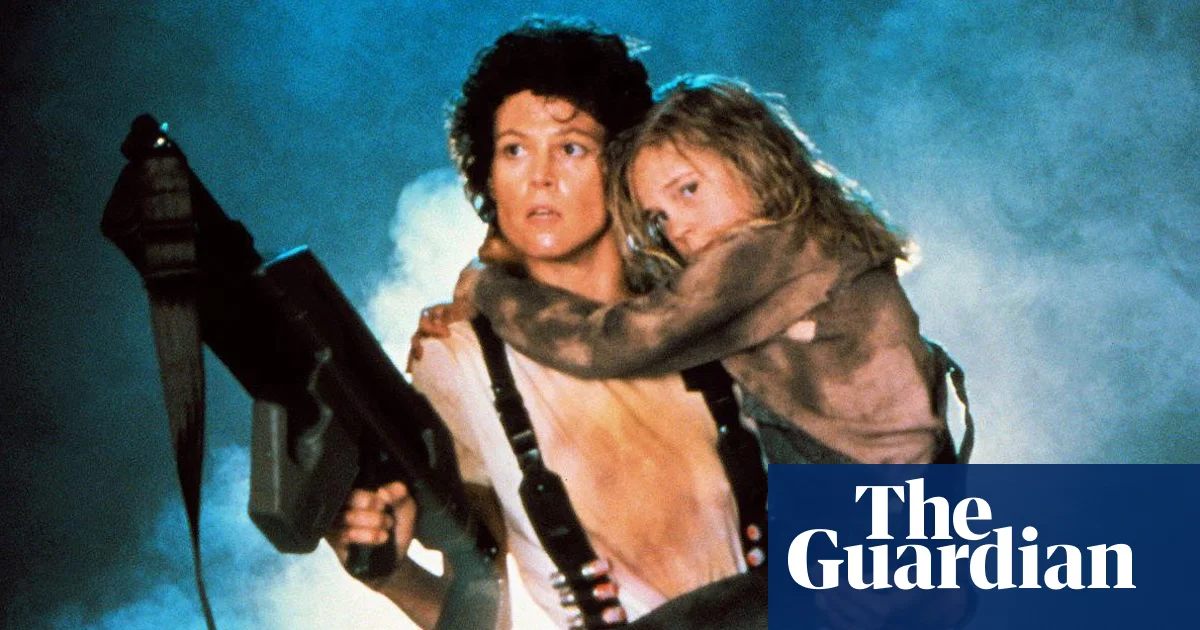
This is the only movie where we see Ripley living safely on Earth, at least for a little while. The Weyland-Yutani corporation presses her back into service to visit the moon where the Nostromo first encountered the creature that killed everyone else on the ship. She reluctantly agrees, in part because she’s faced disbelief over her version of the events from the previous film. She also wants to destroy the creatures. This is where Cameron’s dollar sign comes in: indeed the since-colonized moon has been overrun with HR Giger’s inimitably designed killing-machine xenomorphs, and Ripley, aligned with a group of tough-talking space marines, must fight her way out on a much larger scale, all while protecting an orphaned young girl nicknamed Newt (Carrie Henn).
Somehow, whether through brilliance or opportunism or both, Cameron managed to make an urtext of sorts out of a sequel to someone else’s movie. Ripley protects a child, like the T-800 would go on to do in Terminator 2. The grunts speak in a colorfully cornball-pulp style just like the soldiers in the Avatar movies. The deaths and disasters that befall many of the characters are awesome in the truest sense of the word, just as they are in Titanic. Bill Paxton is there, as he is in most Cameron movies made during his too-brief lifetime. And just like Terminator 2 and Avatar: The Way of Water, Cameron manages to make a sequel that is bigger and brawnier than the original.
Is it better? Hard to say. The original film unnerves with elegance. You could accuse Cameron of replacing that with brute force. (Roger Ebert certainly alluded to that in his original 1986 review, leading with a question: “Do I praise its craftsmanship, or do I tell you it left me feeling wrung out and unhappy?” He landed on a positive notice, bad vibes notwithstanding.) For many fans of the series, it’s a high point – followed by a rollercoaster-like zoom through multiple loops.
What keeps the movie from feeling like a theme-park ride – which is how I’d characterize a movie like Alien: Romulus, entertaining as it is – is Sigourney Weaver’s performance. Yes, Cameron’s craft behind the camera is undeniable, his ensemble is lovable in a way that the surlier Alien crewmates maybe were not, and the action sequences are massively impressive. But Weaver gives a bravura turn as Ripley, and not just as the action heroine intoning “get away from her, you bitch” at the xenomorph queen – which is not to discount that moment, as succinct and effective a bit of hog-wild applause-mongering as has ever been constructed in a genre movie. Weaver gets to play so much here: the take-charge action hero, the Cassandra figure cursed to warn everyone about an impending disaster and watch as it unfolds anyway, the fish out of water within the platoon of soldiers, the final girl on steroids, the surrogate mother. Throughout it all, Weaver maintains her trademark firmness – she can convey a shocking emotional range without the familiar tools of Big Acting. Neither authority nor vulnerability ever disappear from her performance. It should be no wonder that she earned a best actress Oscar nomination for the role. But it still is, because that simply doesn’t happen very often for a sci-fi/action movie.
Because the character feels so fully realized, Cameron and Weaver tapping into Ripley’s fierce protector side (whether or not the audience is aware of her loss as a mother) never registers quite as condescending as it should. The movie never feels like Ripley is redeeming herself by doing motherhood to the extreme, maybe because she arrives in the movie with a clear and righteous objective before she meets Newt, and/or because Cameron forgoes the now highly popular and worn-out cliche of the gruff loner brushing off an eager kid sidekick before finally giving in to warmer feelings.
Despite its continued freshness today – and like a lot of great movies before and after it – Aliens may have done some harm via misinterpretation alongside its countless hours of good. For years at this point, Ellen Ripley has been held up as an example by countless misogynists as proof that actually, they love strong female characters. They love Ripley, they love Sarah Connor, they love certain video game incarnations of Lara Croft (you can guess which ones are loved best); it’s just that Supergirl, Captain Marvel, Harley Quinn, Rey, Furiosa, whoever – take your pick from literally any female character created after 1995 – aren’t doing it right (which is to say, emerging during their childhood, and, more often than not, being written by noted non-woman James Cameron). Aliens, of course, has a lot of woke touches by contemporary standards: Ripley is the unequivocal lead and hero (and isn’t especially sexualized), and supporting character Private Vasquez (Jenette Goldstein) has an ambiguous approach to gender and sexuality that feels well ahead of 1986 mores. But it’s somehow still a cudgel for would-be traditionalists.
It’s an easy mistake to make, not because Cameron is similarly aligned, but because Aliens has become part of the sci-fi/action/horror firmament; it’s so good that a sect of fans will virulently, vocally pretend to pretend that the subsequent entries, largely weirder or gnarlier or thornier in their own ways, don’t exist. Aliens was the last time that virtually everyone agreed that a movie in this series was more or less unimpeachable, and it still is. But its most valuable legacy isn’t the traditionalism it’s accidentally inspired. It’s in the less beloved female action heroes, the less universally cherished creature-feature sequels, and the less shockingly great James Cameron movies that followed. When someone makes a sequel this good, it has a way of opening up entire worlds. Some fans nonetheless just fantasize about a sequel to Aliens. Cameron, even though all of the doom, saw a bigger, more muscular future.
