

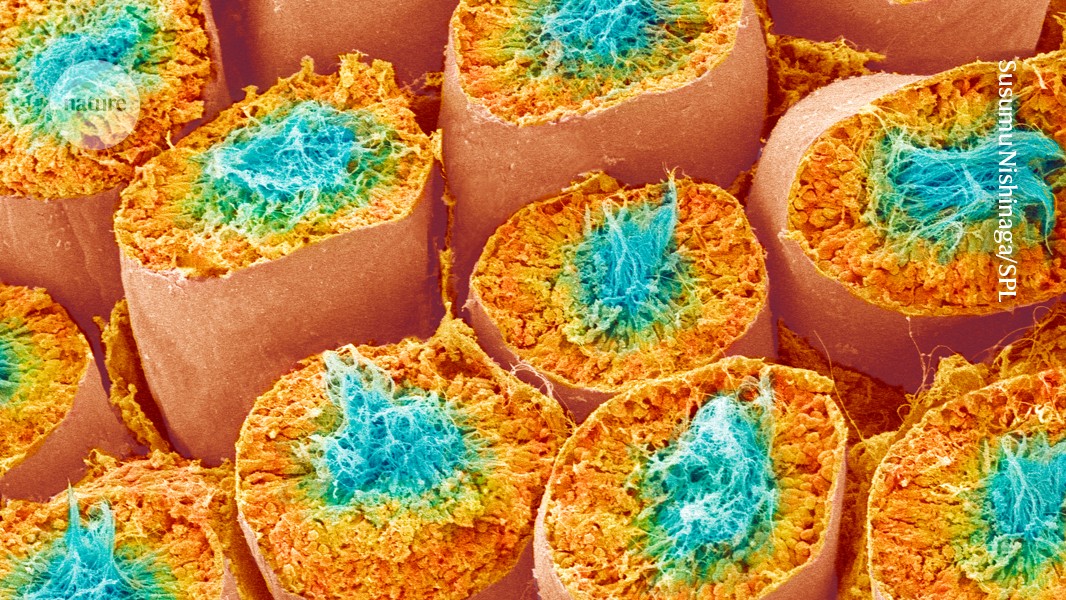
Developing sperm cells (blue; artificially coloured) fill the centre of seminiferous tubules (orange), which form the human testis.Credit: Susumu Nishinaga/Science Photo Library
A cutting-edge operation has restored a man’s ability to make sperm by transplanting tissue samples that were removed from one of his testicles and frozen 16 years earlier, when he was still a boy. Scientists say that the remarkable achievement could mark the beginning of a new wave of fertility treatments.
The samples were taken shortly before the boy received chemotherapy treatments that put his fertility at risk. “This is an important breakthrough,” says Rod Mitchell, a paediatric endocrinologist at the University of Edinburgh, UK, who was not involved in the work. “This offers hope for prepubertal boys who are facing treatments, such as chemotherapy and radiotherapy, that can affect their future fertility.”
The work was presented at the European Society of Human Reproduction and Embryology annual meeting in London last week and was released as a unreviewed preprint1 on medRxiv earlier this year.
Looking to the future
The growing number of children who survive childhood cancer has trained the spotlight on the long-term consequences — including fertility loss — of the aggressive therapies that they receive. From 2002 to 2022, more than 3,000 boys at 16 sites in Europe, Australia and the United States opted to freeze samples from their testicles in the hope that, if they were to become infertile, the tissue could be used to restore their ability to have children2. But clinicians could not assure their young patients and their families that such a procedure would work, says Mitchell.
Lab-grown sperm: scientists inch closer to fertility breakthrough
In 2008, physicians at the University Hospital in Brussels removed a testicle from a ten-year-old boy and froze tissue samples that had been taken from it. The boy then received chemotherapy in preparation for a blood-stem-cell transplant to treat sickle-cell disease.
More than a decade later, he returned to the hospital as an adult with dreams of having children. Clinicians monitored him for two years and confirmed that he could not produce normal sperm on his own. They then grafted 11 of the tissue fragments — which by then had been frozen for 16 years — either into his remaining testicle or under the skin in his scrotum.
The grafts incubated there for a year, bathed in the hormones and other environmental cues found in an adult man. After that, the tissue fragments were removed and examined.
The team found sperm-producing stem cells and signs of active sperm production in several of the transplants. In a sample from one graft, they found a single mature sperm.
At that point, the researchers stopped their analysis and saved the rest of the graft in the hope that more sperm could be collected from it later and used for in vitro fertilization, says Ellen Goossens, a reproductive biologist at Vrije Universiteit Brussel and a co-author of the preprint.
