

Unlock the Editor’s Digest for free
Roula Khalaf, Editor of the FT, selects her favourite stories in this weekly newsletter.
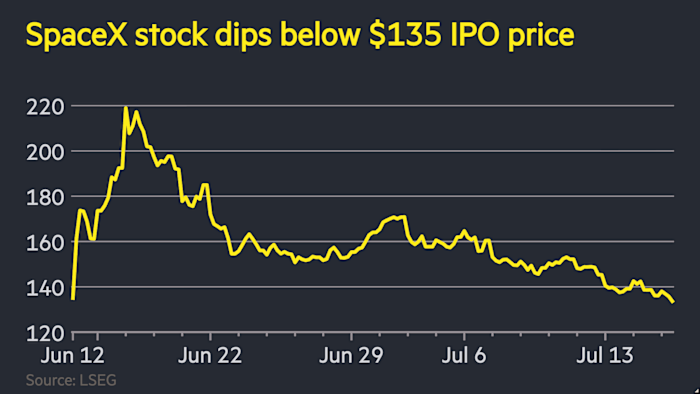
SpaceX on Wednesday slipped below its listing price of $135 per share, extending a slide that has erased more than $1tn from the value of Elon Musk’s conglomerate since the peak shortly after its record IPO.
Shares in SpaceX hit an intraday high of $225 in mid-June, pushing the market capitalisation of Musk’s lossmaking company above Amazon’s in the days after it raised $86bn at a valuation above $2tn in the world’s biggest IPO.
But the shares have since slipped 40 per cent, slashing the value of Musk’s 42 per cent stake to about $760bn from $1.2tn over the same period. SpaceX’s bonds issued in late June have also sold off sharply.
The share price recovered slightly to close just above $135 on Wednesday.
“This is a little bit of a tricky time for the stock,” said an investment banker at one of the lenders that worked on the IPO.
“But we didn’t leave too much money on the table and the people who are buying the stock are actually really smart investors, so I feel very good about who owns it,” the person added.
The more than 20 Wall Street banks that worked on the SpaceX deal shared a fee pool of half a billion dollars, by far the largest IPO windfall of all time. Several of the biggest US lenders this week reported record quarterly profits thanks in part to a speculative trading boom concentrated around AI-linked stocks.
The subsequent slump in SpaceX’s stock price has come as shares in richly valued tech stocks have struggled over the past month over worries about higher US interest rates and the profitability of Big Tech’s huge AI investments.
Goldman Sachs, a bookrunner on SpaceX’s offering, expects the company’s AI revenue to increase 100-fold by 2030. Morgan Stanley, which was in charge of stabilising the rocket maker’s post-listing performance, on Wednesday reported $6.3bn in second-quarter revenues in equities trading, up 70 per cent year on year.
SpaceX three weeks ago raised about $25bn in debt. It has since been among the worst performers in the high-grade bond market.
About 20 per cent of June’s $75bn offering went to Musk’s army of retail traders, an unusually high share for a large-cap offering.
Hedge funds were limited to about 10 per cent of the deal, with the remainder going to long-only managers, sovereign wealth funds and allies of Musk. Several pre-IPO investors are sitting on billions of dollars in unrealised gains.
Insiders are limited from selling shares by the post-IPO lock-up but will be free to offload a huge slug of their shares after SpaceX reports its first quarterly earnings in August.
Further blocks of shares will become available over the following weeks and months, though Musk and other large investors are locked up for the first 366 days after the June listing.
SpaceX was last week added to the tech-heavy Nasdaq 100, benefiting from sweeping rule changes the exchange operator implemented earlier this year that provided a fast-track route on to its index and billions of dollars in passive investments for newly listed companies.
This article has been updated to reflect that Morgan Stanley was not the “left lead” bank on SpaceX’s IPO.
