

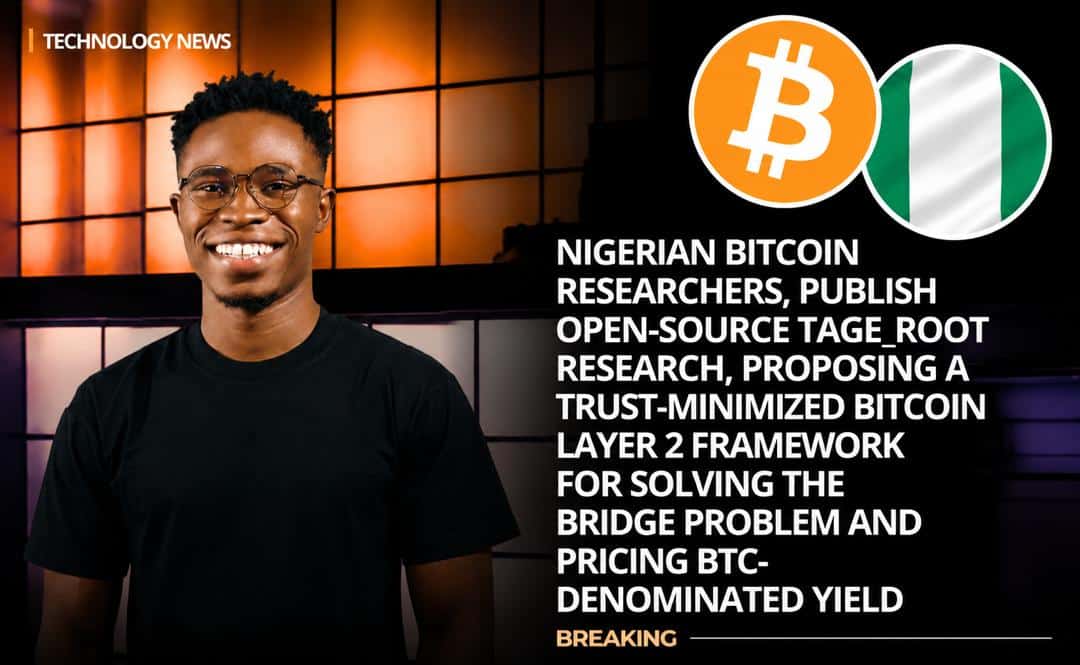
Nigerian Bitcoin researchers Heritage Falodun and others have proposed Tage_Root, a trust-minimized Bitcoin Layer 2 framework aimed at exploring challenges related to Bitcoin bridging and the pricing of Bitcoin-denominated yield.
Bitcoin’s base layer was deliberately designed for settlement finality, not programmable finance. Its UTXO model and constrained scripting language make native staking and yield generation architecturally impossible without protocol extensions.
Today, most Bitcoin yield products introduce trust assumptions, centralized custodians like wBTC, threshold-signature committees like tBTC, or opaque CeFi lending books.
With Tage_Root, Heritage Falodun and Samson Ojo are exploring a different approach: a trust-minimized Layer 2 execution stack where Bitcoin-denominated yield can be generated through real economic activity, users are intended to retain unilateral exit rights, and Bitcoin RPC integration support is included for stronger settlement awareness.
The Tage_Root Rust implementation currently covers:
– bridge: peg-in / peg-out logic, CTV-enforced and BitVM optimistic paths
– covenant: OP_CTV template construction and verification
– execution: lightweight EVM-like execution layer for yield contracts
– yield_engine: lending pool, interest rate curves, and reward distribution
– staking: validator bonding, slashing conditions, and reward accounting
– utils: script encoding, TXID hashing, and Taproot helpers
The research also evaluates relevant Bitcoin Improvement Proposals including BIP-340, BIP-341, BIP-342, BIP-119, BIP-118, BIP-300, and BIP-301, while exploring two deployment paths:
Path A: OP_CTV-based covenant peg construction if BIP-119 is activated.
Path B: BitVM-style optimistic verification using pre-signed transaction trees and fraud proofs. This path is explored as a deployment option without BIP-119 activation but would require online challengers and a liquidity provider layer to support exit delays.
As Tage_Root is open source, Heritage confirmed that the protocol welcomes Bitcoin developers, Rust engineers, protocol researchers, Layer 2 builders, and open-source contributors to open issues and submit pull requests on the Rust implementation.
The team also said it plans to continue publishing technical notes, functions, and follow-up research on emerging developments.
