

Revered as one of Australia’s last true wilderness areas, Takayna/Tarkine is a place of legends. Freshwater crayfish that can reach almost a metre in length lurk in the shade of 2,000-year-old Huon pines, and every few years a rumour emerges that thylacines still prowl the dense Gondwanan rainforest of north-west Tasmania.
For 65m years, this landscape has sheltered all manner of astonishing creatures. But some of the most fascinating life forms found here are even older. Before animals walked the Earth or trees began converting carbon dioxide into oxygen, fungi helped to create the conditions necessary for complex life on our planet. “People often say that fungi grow in the forest,” Dr Alison Pouliot, a mycologist, tells me as we inhale cool air perfumed with the gentle spice of sassafras. “But there wouldn’t be a forest without fungi. Fungi are the ecosystem engineers that created the foundation for the forest.”
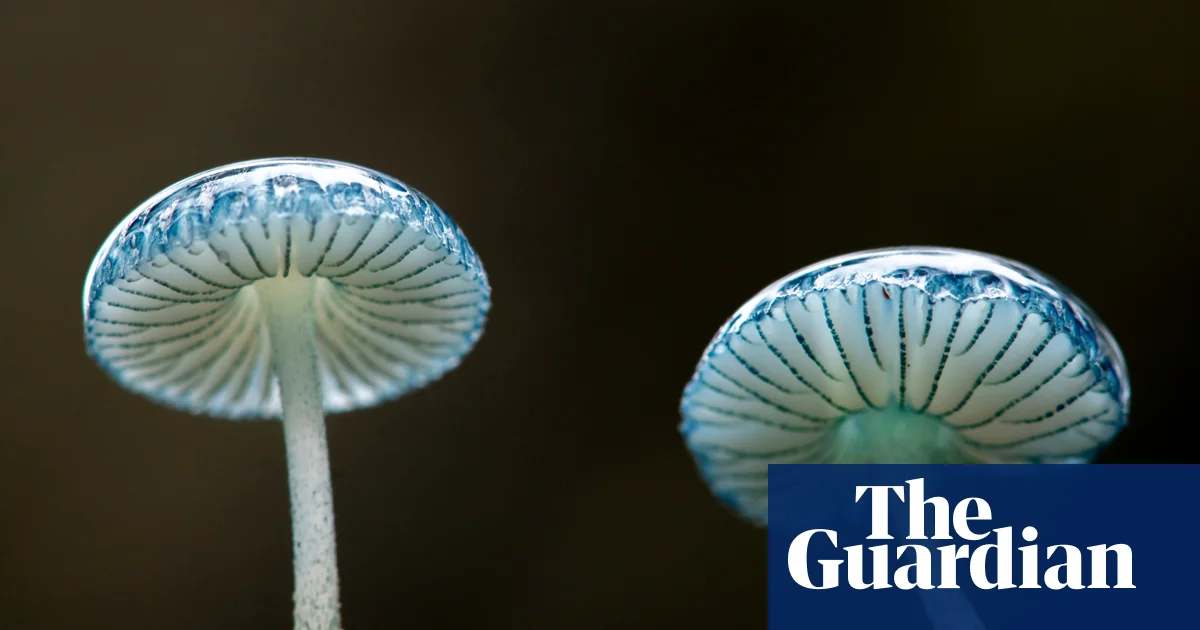
‘Probably the most charismatic species here,’ according to Pouliot, sky-blue pixie’s parasols (Mycena interrupta) have a circle of darker blue in the centre of their caps and resemble an iris from above. Photograph: Alison Pouliot
Joining me on a three-day fungi workshop led by Pouliot are toxicologists, botanists and ecologists, but everyone seems united by a sense of wonder when it comes to fungi. After a few hours in their company, it’s easy to see why.
Long considered plants by taxonomists, fungi were finally given their own kingdom about 50 years ago, but they remain woefully understudied. Researchers estimate that there are 2-3m species, of which just over 205,000 have been identified, and mushrooms are merely the most visible part of complex organisms connected by vast webs of underground threads called mycelium. These networks, all 100 quadrillion kilometres of them, allow fungi to form life-sustaining symbiotic relationships with as many as 70% of plant species on the planet.
Despite their name, jelly babies (Leotia lubrica) are not palatable for humans. But overall, fungi make up to 90% of the diet of some native marsupials on the mainland.
Photograph: Alison Pouliot
“Fungi can be so small they’re invisible to the human eye or inconceivably big,” Pouliot says, citing a specimen in Oregon in the US that covers more than 9 sq km and weighs as much as 30,000 tonnes. But she is not here merely to impart interesting facts.
Her interdisciplinary approach explores the vital role fungi play in ecosystems around the world and their importance in environmental restoration. We listen to a Sylvia Plath poem, take “sporeprints” that create photonegative imprints of a mushroom’s underside and examine how language affects the way we view fungi – why does love bloom, but crime mushrooms?
A single eucalyptus tree can have hundreds of types of fungi attached to its roots. Photograph: Alison Pouliot
In the afternoons, we set out on foraging trips from Corinna Wilderness Village, a former mining town deep in the rainforest that has been converted into a charming eco village. We follow the tannin-stained Pieman River, which flows so slowly the inky black surface forms a perfect mirror, and admire ancient Huon pines bowed low over the water. Pushing through giant ferns that spread across the paths, we walk through stands of majestic leatherwoods, celerytop pines and myrtle beeches whose trunks are completely hidden beneath glistening cloaks of dew-flecked moss, lichen and liverwort.
And everywhere we go, the gentle thrum of birdsong is interrupted by cries of delight whenever the group spots a new type of fungi. There are delicate blue pixie’s parasols and fields of ruby bonnets that look like bright red berries scattered across the forest floor, slime-covered earth tongues that resemble worms pushing up through the ground, giant bracket fungi the size of dinner plates and echidna fungi with thousands of spiky teeth beneath their caps.
The pagoda fungus (Podoserpula pusio) has tiered caps that maximise the efficiency of spore dispersal. Every year fungi across the world produce more than 50m tonnes of spores. Photograph: Alison Pouliot
The wild variety of shapes and colours is matched by the incredible density of fungi, and we often cover less than 200 metres an hour. “It’s hard to believe there’s so much diversity in a tiny space,” says Liz Davis, a workshop attender from Orange, who has been foraging for 30 years and started the Mycology May festival in regional New South Wales. “Fungi hunting anywhere else is never going to compare.” Because much of the fungal life remains invisible below ground, Pouliot says we could come here another 100 times and still find different species on each visit.
It’s easy to get wrapped up in the joy of spotting these weird and wonderful species, especially given my newfound appreciation of their role as architects of the rainforest. To use the parlance of the group, I quickly become “fungally infected”. And yet part of the shared passion is a sense of outrage that this vital kingdom of life remains so undervalued.
This Echidna fungus (Hydnum aff. repandum crocidens) has thousands of needle-like projections on the underside of its cap. Photograph: Alison Pouliot
Fungi are essential to the survival of almost every ecosystem on the planet, but there is not even an agreed-upon collective noun for fungi (as opposed to mushrooms). My mind goes back to Sylvia Plath’s poem Mushrooms, which celebrates the resilience, strength and sheer inevitability of fungi, seeing in them a metaphor for gender equality. In its conclusion, she declares: “We shall by morning/ Inherit the earth/ Our foot’s in the door.” After three days in a rainforest built on fungal foundations, I’m grateful for our own bountiful inheritance of fungi.
Guardian Australia travelled as a guest of Tourism Tasmania and Corinna Wilderness Village
