

Unlock the Editor’s Digest for free
Roula Khalaf, Editor of the FT, selects her favourite stories in this weekly newsletter.
The BBC and Channel 4 are in talks about combining their streaming services, according to the corporation’s new director-general Matt Brittin, who called for a British “sovereign platform” to compete with US tech giants such as Netflix.
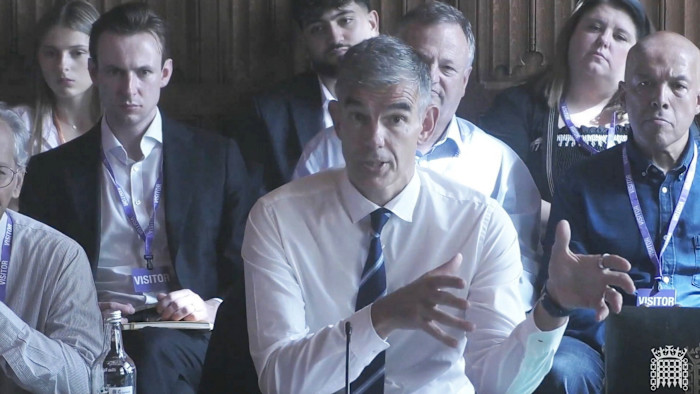
In his first grilling by MPs on parliament’s culture committee, Brittin said on Wednesday that the BBC had “an approach and a conversation” with Channel 4 over the plan, which could see the smaller public service broadcaster join forces with the BBC’s iPlayer.
The UK’s public service broadcasters are facing existential threats as their younger audiences shift to global digital platforms and streaming services, forcing them to cut costs and seek greater scale to compete.
“We have had an approach and have had a discussion with Channel 4,” said Brittin. “In the world of the ITV-Sky merger, Channel 4 looks very sub-scale. All of these mergers are driven by the need to have scale. One opportunity for them would be in partnership with the BBC, having content on iPlayer, but continuing to be ad-funded.”
Channel 4 was approached for comment.
Brittin said there was “an array of commercial, audience, public service and technical issues” but that the prospect of this tie-up would be explored “as quickly as we’re able, because I think that’s something that’s going to be important for public service media”.
He added: “This is a moment of real jeopardy, because of the scale and because of the influence of a handful of US and Chinese tech players [which] will dominate the creation and distribution of content.”
Brittin also said that there was a “compelling” argument for making UK viewers of streaming services pay the licence fee to help raise money for the corporation, criticising the existing regime as “yesterday’s model, it’s a busted flush, it’s no longer fit for purpose”.
Brittin said the current licence fee was a “straitjacket” and that the BBC was “locked into yesterday’s model of consumption, the licence fee being payable on linear television and iPlayer when the world’s moved on”.
Audiences had shifted to streaming platforms, which he said meant that people in the UK could be expected to pay the licence fee if they watched TV on these newer platforms in the same way as people did when watching ITV.
Under a “streamer levy”, he said, “if you watch Netflix, arguably YouTube, TikTok, any other streamer, you would pay. I think that’s compelling in terms of extending it to reflect the reality of today’s audiences.”
However, he admitted that there would be potential problems in trying to enforce this. While about 94 per cent of the UK uses BBC services, only about 80 per cent pay the £180 annual licence fee.
Brittin told MPs that recent attempts to encourage people to pay the licence fee were working, including a QR code being shown during its World Cup coverage. He said that the England vs Mexico match was the biggest audience that the BBC has had in that time slot, with more than 9mn watching the game at 1am on Monday.
Brittin became director-general of the BBC earlier this year, and has already warned of tough cuts to the corporation as part of plans to reduce costs following freezes to the licence fee under previous governments.
The BBC is now talking to the government about the future of the licence fee as part of its 10-year charter renewal process.
