

Good morning and welcome to FirstFT. In today’s newsletter:
-
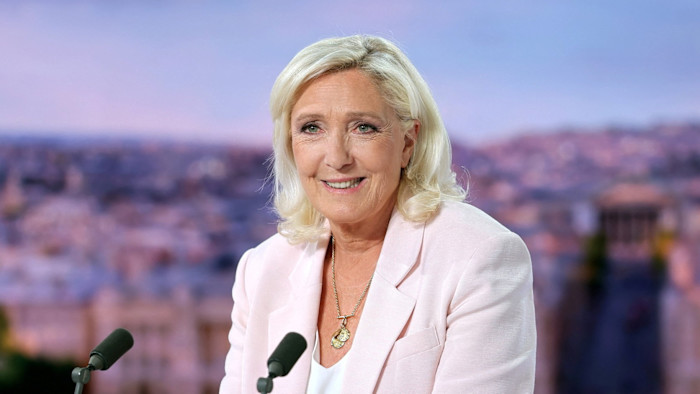
France’s Marine Le Pen to run for president
-
Nigel Farage’s gambit undercut by rivals’ refusal to participate
-
Donald Trump threatens to remove all US troops from Europe
-
Meta tests ‘super sensing’ AI glasses
You can listen to today’s top news stories in the FT News Briefing podcast.
We begin in France, where far-right leader Marine Le Pen has said that she will run for president.
What to know: Le Pen has announced she would seek the French presidency despite judges upholding her embezzlement conviction, setting up an unprecedented election campaign next year.
“I am a candidate for president tonight,” she told TF1 news channel yesterday evening, adding that she would appeal the conviction to France’s highest court for criminal and civil matters. “My hands are clean today. I will go to the Court of Cassation to prove it.”
Why it matters: Le Pen’s decision ends more than a year of uncertainty over whether she or her handpicked successor, Jordan Bardella, would lead the Rassemblement National’s campaign to replace President Emmanuel Macron.
But Le Pen is making a risky bet that voters will back her despite the conviction on corruption offences. No presidential candidate in France has ever run with such a record.
In polls taken before the verdict, Le Pen was far ahead of rivals in potential first-round match-ups to take place in April. But the surveys showed mixed outcomes in a run-off, with Le Pen losing out to certain opponents, including the centre-right leader Édouard Philippe who was polling second. Read the full report.
-
Opinion: Le Pen is posing as a victim of a politicised judiciary. That strategy might play well with her core voters, but the French as a whole don’t buy it, writes Ben Hall.
Here’s what else I’m keeping tabs on today:
-
Nato summit: Alliance leaders are in Ankara, with US President Donald Trump expected to meet Ukrainian leader Volodymyr Zelenskyy.
-
US: The Federal Open Market Committee releases minutes from its June meeting, Kevin Warsh’s first as central bank chair.
-
Global economy: The IMF releases its latest World Economic Outlook Update. The fund yesterday named former Bank of England policymaker Silvana Tenreyro as its next chief economist.
Five more top stories
1. Reform UK leader Nigel Farage said he would stand down as an MP to fight a “people versus the establishment” by-election in his Clacton seat, in a dramatic bid to shore up his political future that was swiftly undercut by rival parties’ refusal to participate in the vote.
-
Election gambit: Farage has responded to scrutiny over his finances by calling a by-election. Here’s why the move may yet fall flat. Clacton voters, on the other hand, welcome the decision.
2. The US and Iran traded military strikes after American forces said the Islamic republic had attacked ships in the Strait of Hormuz, as tensions again rose between Tehran and Washington. US Central Command announced the strikes last night, hours after the Treasury revoked a general licence allowing sales of Iranian oil.
3. Trump has said he could remove all American troops from Europe, in one of his broadest threats yet to allies in the region as he visited Ankara for the Nato summit. The US president also revived his calls for the US to take control of Greenland, potentially reigniting a crisis that could put transatlantic unity in peril.
4. Exclusive: Santander has overhauled its Asia-Pacific business under new management, removing its top banker in Beijing, tightening employee oversight and scrapping perks. The changes reflect the Spanish lender’s efforts to expand in fast-growing Asian markets while tightening costs and oversight to boost profitability.
5. Exclusive: Meta is testing a prototype of “super sensing” AI glasses that would use cameras and audio recordings to capture a wearer’s every moment. But the product has also prompted internal debates over how to handle novel privacy challenges, including non-wearers finding the technology invasive.
The Big Read
In the years following its founding in 2003 with a mission to help defend the west from another 9/11-style terrorist attack, Palantir single-handedly revolutionised the US defence industry.
It did so in part by creating a new role: the “forward-deployed engineer”, who catered to the needs of clients ranging from police forces to chemicals groups and adapted Palantir’s platforms to suit.
With such engineers and its advanced technology, Palantir helped build software programs that, according to those who have used them, saved lives on the battlefield and helped bring an end to the Covid-19 pandemic.
But Palantir has also produced data intelligence platforms used by the Trump administration to detain and deport migrants. The tech group’s enthusiastic embrace of Trump’s policies and its defence of Israel’s war in Gaza have spurred protests and political outrage but also unease among staff.
Insiders and investors fear its growing notoriety will imperil the core of its $330bn business, drive away corporate customers and threaten a business model based on retaining skilled engineers. Is Palantir too tied to Trump?
We’re also reading . . .
-
The joy of tangible media: Sony’s plan to drop physical discs endangers the company and its customers, writes Brooke Masters.
-
Flight disruption: Private jet operators in Europe are braced for fuel shortages this summer, with Nice airport already reporting low supply.
-
Liberal democracy in retreat: Celebrations in the US for its 250th anniversary are in part a wake, writes Martin Wolf. What does the future look like?
Chart of the day
Europe’s heatwave is putting policymakers under pressure to prepare for increasingly deadly conditions on the fastest-warming continent. Read what measures local and national authorities are taking.

Take a break from the news . . .
Opportunities are widening for those who have always wanted to have a French vineyard, as a record number of properties go up for sale at low prices. But is owning one really worth it, asks Alice Kantor.

