

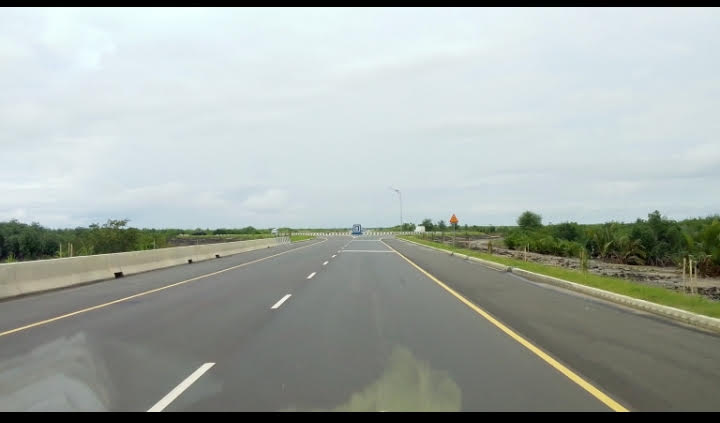
For nearly 70 years, Bonny Island remained one of Nigeria’s most economically strategic yet physically isolated communities, accessible only by water or air despite its immense contribution to the nation’s oil and gas industry. Today, that long-standing isolation has finally come to an end with the completion of the Bodo-Bonny Road, a landmark project delivered through a partnership between the Federal Government and Nigeria LNG Limited (NLNG). From decades of unfulfilled promises to the engineering feat that made it possible, Blessing Ibunge writes that the road is transforming mobility, trade, investment and livelihoods, while reconnecting Bonny to the Nigerian mainland
For decades, Bonny Island occupied a unique position in Nigeria’s economic history. Despite serving as one of the country’s most strategic oil and gas hubs and contributing enormously to national revenue, the island remained physically isolated from the mainland.
Access to Bonny, home to Nigeria LNG (NLNG), the Bonny Oil Terminal and several other critical energy assets, was restricted to waterways and, for a privileged few, air travel and for generations of Bonny residents, a road connection to the mainland remained an elusive dream.
For decades, logistics to Bonny depended entirely on waterways stretching more than 50 nautical miles to Port Harcourt. The route was not only costly but dangerous, exposing residents, workers, and supply chains to piracy, harsh weather, and avoidable loss of lives and cargo.
As one community leader put it, travelling to Bonny by sea often required “prayer and preparation,” because of the unpredictability of the waters.
Life Before The Road
For many Bonny residents, travelling to Port Harcourt was more than a routine journey.
Adolf Ransom Pepple, Chief Press Secretary to the Amanyanabo of Grand Bonny Kingdom, described the anxiety that accompanied every trip. He said “Before this road, travelling to Bonny required prayers and fasting. You prayed against rough waters, against criminal attacks and against every uncertainty associated with sea travel.”
His recollection resonates with many residents.
Chief John Osondu, Chairman of the Bonny Ultramodern Market Association, vividly remembers losing goods worth millions of naira to sea pirates in 2017 while returning from Aba.
“They ambushed us on the waterways, seized our goods and held us captive,” he recounted. “Many traders suffered similar experiences.”
Victor Tamunosaibibam Pepple, another resident, shared a similar ordeal.
“Sea pirates captured us and took us to their hideout. I know what I suffered during that period,” he said. “The advantages of this road cannot be compared to what we experienced travelling by water.”
A Vision Delayed
According to Bonny elders and community leaders, the idea of a road connecting Bonny to the mainland dates back to the early 1950s.
It was learnt that the idea of a road linking Bonny Island to the mainland first emerged during the early oil era, when Shell’s export terminal turned the island into a strategic petroleum hub. But despite its importance, successive administrations struggled to move beyond drawings and promises.
By the Second Republic, portions of infrastructure had begun on the Bodo axis, including an abandoned bridge span that symbolised repeated policy reversals.
Adaobu Blue-Jack, Assistant Secretary of the Bonny Consulate, recalled that as far back as 1953, shortly before Shell commenced major operations in Bonny, the father of the current Amanyanabo of Bonny Kingdom raised concerns about the island’s isolation.
“He asked a simple question,” Blue-Jack said. “‘If there is an emergency or disaster, how will my people escape?’ The answer then was by sea. He insisted there should be a road.”
That request remained largely unanswered for decades.
Although the Federal Military Government under General Yakubu Gowon approved designs for the project in the early 1970s, the proposal remained trapped on drawing boards. Successive administrations made promises, but little progress followed.
A bridge span constructed during the Second Republic was abandoned, becoming a monument to unfulfilled political commitment, meanwhile, Bonny residents continued to rely on water transportation, often navigating dangerous waterways vulnerable to bad weather, accidents and piracy.
“The risks and losses suffered over the years cannot be fully quantified,” Blue-Jack said.
That Dream Has Become Reality
The completion of the 37.9-kilometre Bodo-Bonny Road, linking Bonny Island to the mainland through Bodo in Gokana Local Government Area of Rivers State, stands as one of the most significant infrastructure achievements in the Niger Delta in recent times.
With the completion of the Bodo-Bonny Road, a project conceived in the early 1950s, approved in principle in 1973 under the military government of General Yakubu Gowon, and finally delivered under a public-private financing arrangement involving the Federal Government and Nigeria LNG Limited (NLNG), Bonny is no longer an isolated industrial enclave at the edge of the Atlantic. It is now physically tied to the mainland.
More importantly, it represents the fulfillment of a vision first articulated over seven decades ago.
The Breakthrough
The turning point came when the Federal Government and NLNG adopted a structured financing arrangement, anchored on tax credits and cost-sharing, to deliver the project.
The arrangement was later strengthened after high-level engagements involving the Amanyanabo of Bonny Kingdom and the Presidency, culminating in approval for NLNG to finance the road as part of its long-term operational efficiency and community development obligations.
The breakthrough came through a unique public-private partnership involving the Federal Government and NLNG. Under a tax-credit arrangement approved by the Federal Government, NLNG undertook substantial financing of the project, while Julius Berger Nigeria Plc handled construction.
A member of the Bonny Chiefs’ Council described the arrangement as “symbiotic,” noting that NLNG’s investment logic aligned with both corporate efficiency and national development priorities.
The project was eventually awarded to Julius Berger Nigeria Plc, whose engineering capacity proved critical in navigating the swampy terrain, tidal creeks, and unstable soil conditions that define the Niger Delta coastline.
A major turning point came on October 12, 2017, when then Acting President Yemi Osinbajo performed the ground-breaking ceremony for the project.
For Bonny residents, it was a moment of cautious optimism.
“It was like a festival,” recalled Adolf Pepple. “People felt that freedom had finally arrived.”
Yet, funding challenges and difficult terrain threatened to slow progress.
Blue-Jack credited the current Amanyanabo of Bonny Kingdom, King Edward Asimini William Dappa Pepple III, for relentlessly pursuing the project.
“The King engaged President Muhammadu Buhari and advocated strongly for NLNG to utilise tax credits to fund the road,” he said. “That intervention was crucial.”
Chief Abel Attoni, Chief and Head of Attoni House in Finima, a member of the Bonny Chiefs Council, also praised the monarch’s role.
“The King saw the future,” Attoni said. “He understood that Bonny’s development required accessibility.”
Engineering Through The Swamps
Constructing the road was anything but straightforward. The project traverses difficult marshland, swamp forests and tidal waterways.
According to Julius Berger, the scope included construction of nearly 39 kilometres of roadway, major bridges across Afa Creek, Nanabie Creek and the Opobo Channel, as well as extensive dredging and specialised soil stabilisation works.
Project Manager, Engr. Tim Nippert, recently confirmed that the road itself has been completed. “The project is completed,” he stated. “What remains are tree planting, streetlight foundations and some finishing works.”
He noted that despite the engineering complexities, Julius Berger completed the project within budget and generated savings now being deployed for additional infrastructure such as street lighting and landscaping.
Minister of Works, Senator David Umahi, described the project as a remarkable engineering achievement.
“This is a coastal route through marshy terrain,” Umahi said during an inspection. “If we were to award this project today, it would cost well over ₦15 billion per kilometre.”
The Minister of Works has already confirmed that the project cost estimated at about ₦7.4 billion per kilometre due to difficult terrain was justified by engineering realities, adding that additional upgrades including solar lighting, CCTV systems, and landscaping are underway.
Analysts describe the road as a “strategic enabler,” improving evacuation logistics, reducing operational costs for multinational companies, and strengthening national energy security.
Economic Transformation Begins
Although the road is yet to receive formal presidential commissioning, its impact is already evident. Residents say transportation costs have fallen dramatically.
For Bonny residents, the road is more than concrete and asphalt. It is a structural shift in the island’s economy.
Before its opening, transportation costs to Port Harcourt reached as high as ₦15,000 per trip. With road access, fares reportedly dropped to about ₦5,000, while travel time and risk were significantly reduced.
The impact on trade has been immediate. Goods that once moved through layered logistics chains via water now arrive directly by truck. Market associations report increased inflow of staple commodities such as garri, cement, and building materials, with daily truck deliveries replacing unpredictable marine freight schedules.
A trader at the Bonny Ultramodern Market recalled losing goods to sea piracy in 2017. Today, he says, “you can go to Aba and return the same day.”
Boma Benibo, a native of Buguma in Asari-Toru and the only female driver who has switched over to the Bonny Line, said “I started plying the Bonny route in January. All my lifetime, I have not been in Bonny. It is when this road came that I decided to switch over.
“Honestly, I think the Bonny line is okay. With the way the work is going, I load from Port Harcourt, Abali Park to Bonny. I think I like the journey.”
On his part, the Branch Chairman of the National Union of Road Transport Workers (NURTW), Bonny, Dagogo T. Banigo, who expressed excitement on the new development, said the road has helped in view of development.
“It has added to the economic benefit, reducing the risk of commuters. We, as a trade union, have also expanded our business, cushioning off stress to Bonny and its environs. So, it is a welcome development to us and residents.”
Banigo recounted: “Prior to the opening of this road, peradventure boats break down in sea, the emergency response to rescuing of passengers is always strenuous, sometimes people drown even before help comes. But this time, vehicle plying Bonny, Bodo, Bori, Eleme via Port Harcourt, or even Aba, Akwa-Ibom, if there is any challenge, the driver communicates because we have duplicate of manifest of every driver of vehicle that enroute here from the park. So, there is always a quick response to go back to convey the passengers.
“For business men and women, unlike before, today being Wednesday market day, if you travel outside Bonny to get products, sometimes it takes the traders days to get back to Bonny because of traffic with the population accessing the boats. But in this case, people that enrooted to Aba, or other cities for business, there are tendencies and possibility that they are coming back the same day via vehicle. So, it is a huge advantage rather than disadvantage.”
Amaopusenibo Fred Stephen Pepple, Vice-President of the Titled Citizens of Bonny Kingdom, recalled that sea transport fares had risen to as much as ₦15,000 per trip before the road became operational.
“Once the road opened, fares dropped to around ₦5,000,” he said. “The difference was immediate.”
The road has also transformed trade. According to Chief Osondu, traders can now travel to Aba, purchase goods and return the same day.
“Today, trucks bring products directly into Bonny,” he said. “Before now, goods had to be offloaded at the waterfront and transferred several times before reaching the market.”
Building materials are also arriving more easily and at lower costs, creating opportunities for rapid expansion in the real estate sector.
Blue-Jack believes this could trigger a construction boom.
“When it becomes easier and cheaper to transport cement, steel and other materials, development naturally accelerates,” he said.
Tourism and Investment Opportunities
Tourism is emerging as one of the biggest beneficiaries. Bonny’s rich history, cultural heritage and annual festivals have long attracted visitors. However, transportation difficulties limited attendance. The road is changing that.
Beyond commerce, the road has reshaped Bonny’s social and tourism landscape. Events such as the annual Bonny Boat Regatta, the King’s cultural festivals, and seasonal celebrations have seen increased attendance, with visitors now arriving in large numbers by road rather than by boat.
Community leaders also point to rising school excursions, further stimulating local businesses, increased hospitality activity, transportation, shopping centres and housing developments, and a growing interest in Bonny as a tourism destination.
One senior community figure noted that over 1,000 visitors attended cultural events at the Bonny Consulate Cinema within a single year, a figure attributed largely to improved accessibility.
Blue-Jack disclosed that visitor numbers surged during the 2025 festive season. “There was a remarkable increase in arrivals because people could drive directly into Bonny,” he said.
The Bonny Boat Regatta, held annually on December 26, witnessed significantly higher attendance.
Adolf Pepple noted that many visitors arrived in their personal vehicles, something previously impossible.
Bonny Consulate Cinema, another growing attraction, has recorded increased patronage from visitors coming from outside the island.
Security And Emergency Response
Despite the optimism, authorities and community leaders acknowledge ongoing security management concerns. To mitigate risks, movement on the road is currently regulated, with closures typically enforced from 7:00 p.m. to 7:00 a.m. Security checkpoints and controlled access remain part of the operational framework, reflecting the strategic sensitivity of Bonny as a major oil and gas hub.
The presence of military formations and coordinated community security structures has helped maintain stability since the road’s partial opening.
Beyond economics, the road has introduced a new dimension to security and emergency management. For the first time, Bonny has a reliable land evacuation route.
Blue-Jack described the road as “the visa we have been waiting for.”
The road has also improved access to tertiary healthcare facilities in Port Harcourt and elsewhere.
Attoni, however, emphasised the need for vigilance.
Given Bonny’s concentration of strategic oil and gas infrastructure, he said stringent security measures remain necessary.
“So far, the arrangement is working,” he said. “There have been no significant security incidents reported on the road.”
A Model Partnership
Beyond its physical significance, the Bodo-Bonny Road has become a model of collaboration between government, host communities and the private sector. The project demonstrates how innovative financing mechanisms can accelerate critical infrastructure delivery.
Community leaders unanimously acknowledge NLNG’s pivotal role.
“Without NLNG, I don’t think we would be where we are today,” Attoni said.
He described the company as “almost part of the Bonny community.”
The Federal Government has also approved Phase Two of the project, signalling continued commitment to expanding connectivity in the region.
Minister of State for Works, Bello Goronyo, recently described the road as “a bridge to opportunity, a lifeline for commerce and a symbol of national cohesion.”
NLNG Narrating Their Success
The NLNG has also expressed fulfillment at the completion of the road project, after in September 2017, they went into the road construction agreement with the Federal Government of Nigeria in what would become a significant social investment project for Nigeria.
Sophia Horsfall, General Manager, External Relations and Sustainable Development, recounted “The Bonny-Bodo Road project, is a NGN280 billion public-private partnership with the Federal Government of Nigeria, through the Ministry of Works, that now connects Bonny Island to the mainland of Rivers State for the first time, unlocking trade, huge economic opportunities and improving livelihoods.
“Prior to the construction of the road, Bonny community being an island relied exclusively on air and water transportation to access the mainland and other parts of Nigeria. Use of these routes was constrained by challenging weather conditions, travel uncertainties, safety concerns, and relatively expensive transportation costs for residents, businesses, and visitors alike.”
Horsfall noted that “NLNG’s intervention facilitated the completion of the 38-kilometer landmark infrastructure”, stressing that it aligns with NLNG’s vision of transforming lives sustainably by transforming Bonny into a potential modern global tourism hub and accelerating its development to a premier destination to live and visit.
More Than A Road
For many Bonny residents, the significance of the Bodo-Bonny Road transcends concrete, steel and asphalt.
It represents the fulfilment of a dream passed from one generation to another.
For the people of Bonny, the road represents more than mobility. It is a correction of historical limitations. It is also a reminder that infrastructure, when sustained by political will, corporate partnership, and community engagement, can redefine not only geography but economic destiny.
“My grandfather dreamed about this road but never saw it,” said Victor Pepple. “My father also hoped for it but did not live to witness it. I am fortunate that in my lifetime, I can drive on this road.”
After more than 70 years of waiting, Bonny Island is no longer isolated.
For a kingdom that has contributed immensely to Nigeria’s economic prosperity, the Bodo-Bonny Road is not merely infrastructure. It is a long-overdue connection to opportunity, security, growth and the future.
