

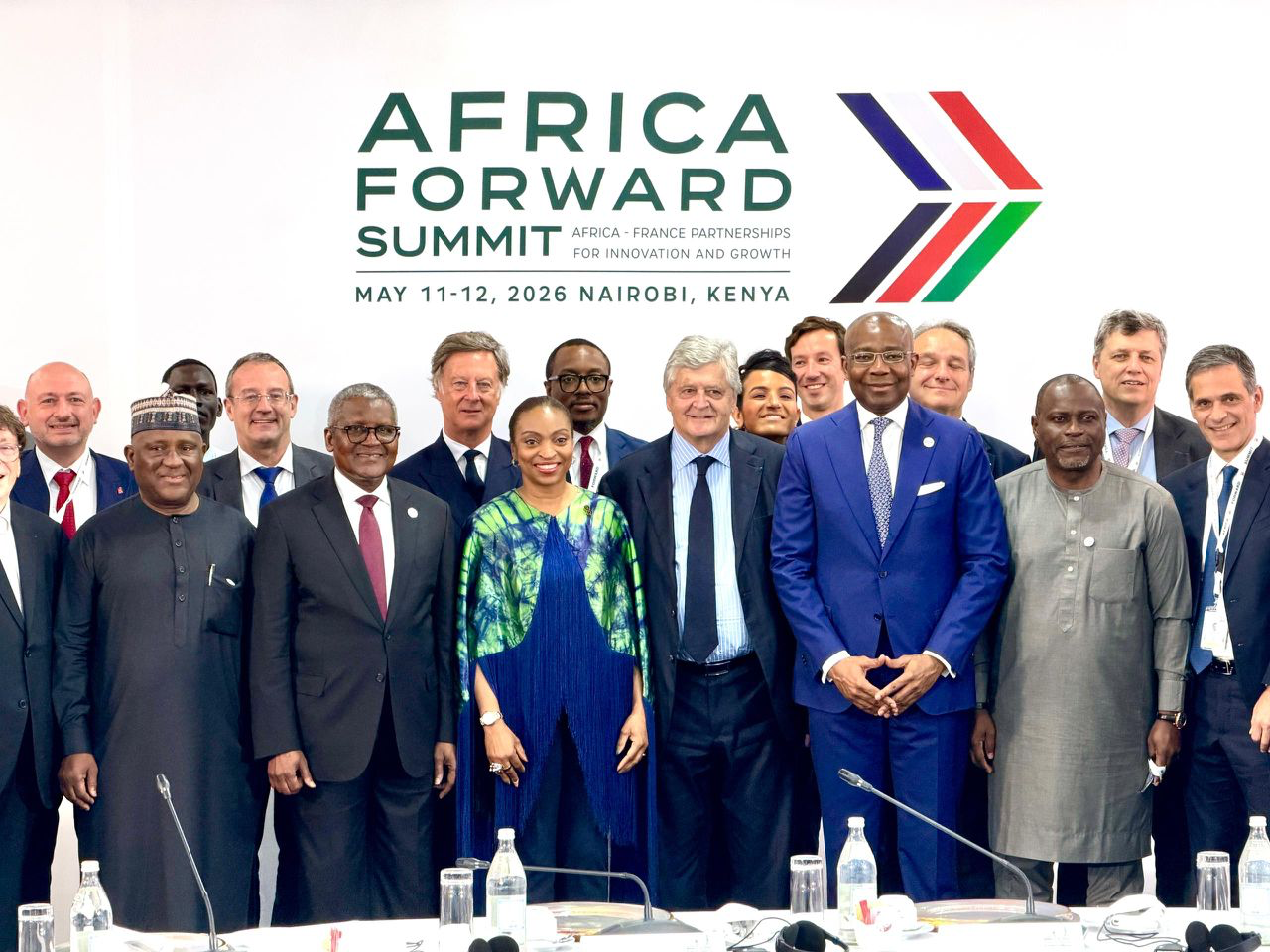
The 10th France-Nigeria Business Council, held on the sidelines of the Africa Forward Summit in Nairobi recently, underscored the growing economic partnership between Nigeria and France as Paris expands its engagement beyond its traditional Francophone allies. With bilateral trade reaching $4.7 billion in 2025 and Nigeria remaining the largest destination for French investment in sub-Saharan Africa, the summit showcased how the two countries are translating diplomatic goodwill into tangible investments spanning banking, energy, hospitality, agriculture and other strategic sectors, Uzoma Mba reports
As France looks beyond its traditional Francophone comfort zone in Africa, Nigeria, a country with no colonial history with Paris, has been quietly deepening its commercial ties to France.
On May 12, 2026, on the sidelines of the Africa Forward Summit in Nairobi, the two countries convened the tenth meeting of the France-Nigeria Business Council (FNBC), the institutional machinery driving the engagement.
The summit itself was a marker of that shift: the first time France had convened such a gathering in an Anglophone African country, and a further sign of Paris intentionally diversifying its Africa strategy toward the continent’s larger, English-speaking economies.
President Bola Tinubu was in Nairobi for the two-day event, which paired a programme for Heads of State and Government with a business forum on youth, creative industries, peace and sport, and a side event for First Ladies.
Also on the sidelines was the French-Nigeria Business Council meeting – chaired for Nigeria by Minister of Industry, Trade and Investment Jumoke Oduwole and for France by Minister Delegate Nicolas Forissier. President Tinubu, whose remarks were delivered by Minister Oduwole, welcomed the Council’s tenth outing by declaring the partnership had entered “a new chapter of serious economic execution.” The numbers agree: bilateral trade hit $4.7 billion in 2025, and Nigeria remains the top destination for French investment in sub-Saharan Africa.
The deals
The clearest evidence that the Council is more than a photo opportunity lies in a series of banking and energy deals over the past few years. In May 2023, Access Bank UK opened a Paris branch, built to finance trade flows, particularly between France and Africa. The launch was attended by the late Herbert Wigwe, then Access group chief executive, and also the newly appointed President of the Business Council.
Eighteen months later, in November 2024, Zenith Bank followed with its own Paris branch, commissioned by Finance Minister Wale Edun on the sidelines of President Tinubu’s state visit to France – the culmination of a memorandum Zenith chairman Jim Ovia had signed with French trade minister Olivier Becht a year earlier. UBA has since moved toward full banking operations in France as well, with Tony Elumelu describing it as the natural next step for a bank already present in the United Kingdom and United States.
The energy sector has delivered equally consequential outcomes. TotalEnergies and NNPC took a final investment decision in June 2024 on the Ubeta gas field, whose output is earmarked to feed Nigeria LNG’s long-delayed Train 7.
Further downstream, Abdul Samad Rabiu’s BUA Group has turned to French engineering house Axens as one of the major technology vendors to build its planned 200,000 barrel-a-day greenfield refinery in Akwa Ibom. And in the other direction, the Dangote refinery has turned France into one of its more important jet fuel customers.
The Council
The FNBC was inaugurated in June 2021 by Macron himself, part of France’s broader push to rebuild economic relevance in Africa beyond the countries it once colonised. It groups thirteen members on the Nigerian side – a roll call of the country’s largest private fortunes: Aigboje Aig-Imoukhuede, Aliko Dangote, Abdul Samad Rabiu, Tony Elumelu, Jim Ovia, Mike Adenuga, Gilbert Chagoury, John Coumantaros, Kola Karim, Leo Stan Ekeh, Daisy Danjuma and Flutterwave’s Gbenga Agboola.
Aig-Imoukhuede, the Access Bank co-founder, was appointed the Council’s president by Macron at the Choose France Summit in May 2024, following Wigwe’s death, and it was under his chairmanship that the tenth meeting produced its clearest new deliverable: a signed agreement between Accor and Nigeria’s Shoreline Group to develop a network of 10 hotels with over a thousand rooms by 2030.
On the French side, the Council draws its weight from the chief executives with the deepest Nigerian exposure – TotalEnergies’ Patrick Pouyanné and CMA CGM’s Rodolphe Saadé among them, alongside Danone and Accor, plus government ministers. Ten meetings and five years later, the Council is proving itself as a reliable platform for converting ambitions into concrete investment.
Beyond the founders
What that roll call makes plain is that the Council is, for now, largely a single-generation gathering. Dangote, Rabiu, Elumelu, Ovia, Adenuga and Chagoury are in their sixties and seventies, Chagoury is eighty. All are far advanced in their business careers. The membership also skews heavily toward two industries – banking and energy. Flutterwave’s Gbenga Agboola is the outlier, with a business built entirely in and for the Internet era. But him – and others like him – are the obvious answer to the open question of what a second-generation Council might look like, and whether it moves beyond oil, gas and traditional banking into the sectors where Nigeria’s younger economy is actually growing: fintech, logistics, creative industries, agritech.
Olawale Rotimi Opeyemi – Founder and Chief Executive of JR Farms belongs to the emerging generation, and has accomplished enough to put him at the vanguard of Nigeria-France business relations, from an agriculture perspective. Among other things his business supplies France with African coffee. This week he’s convening, in collaboration with the Franco-Nigeria Chamber of Commerce and Industry (FNCCI), the inaugural edition of a France-Nigeria Agri-Summit in Lagos.
His summit is one of a growing series of French-Nigeria bilateral platforms that sit outside the Business Council’s own structure, but are no less determined to bolster the bilateral relationship. Another one is the France-Nigeria Business and Human Capital Development Forum that was hosted by the Lagos Business School and the French Embassy in June.
French Ambassador to Nigeria, Marc Fonbaustier, said, at the Forum: “France brings world-class expertise in research, higher education, innovation, sustainable agriculture, technology and industry, while Nigeria offers immense talent, creativity and economic potential. When these strengths come together, they create opportunities greater than the sum of their parts. Our partnership is about building ecosystems, strengthening institutions and empowering people.”
After Macron
The deeper vulnerability embedded within the momentum of recent years is more structural than generational. The French-Nigeria Business Council is a presidential creation, launched by Macron in 2021, with him appointing the President. President Macron’s own term ends in May 2027, and the French constitution bars him from seeking a third consecutive term, which means whoever succeeds him will inherit a bilateral vehicle they did not build.
However, from a strategic standpoint, any future French administration would be far better served adopting and scaling this pre-built framework. In today’s competitive African market, building on established trust is a much smarter play than starting from scratch.
Nigeria finally has an Ambassador in Paris, 3 years after the last one tragically died in office. Ayodele Oke was confirmed in April 2026 as ambassador to France, a second posting to Paris for a career diplomat and intelligence chief whose four decades in the foreign service have also taken him through Bangui, Islamabad, Gaborone, Algiers and London.
An experienced hand in the embassy strengthens the Nigerian side of the relationship, regardless of who occupies the Élysée, but it does not, on its own, answer the question of whether a future French president will keep convening a council named for a predecessor’s Africa strategy, or will move on to other pressing priorities.
The Council’s defenders would argue that this is precisely why the deals matter more than the diplomacy: Zenith Bank’s presence in Paris, a Total gas field feeding NLNG, a BUA refinery under construction by French engineers, African coffee brands in the French market, or even a possible Flutterwave play – these do not require a summit to keep functioning.
As Ambassador Fonbaustier said at the Lagos Business School in June, “The future of France-Nigeria relations will not be written only in diplomatic meetings. It will be written in laboratories, classrooms, start-ups and partnerships such as the one we celebrate today.”
And in the words of President Tinubu, “We are ready for investment that builds, capital that produces, and an enterprise that creates jobs. Nigeria and France are no longer simply exchanging goodwill.”
Forward look
If the France-Nigeria model works as intended, the attention will shift to the rest of Europe, especially to the bigger economies like Germany and Italy, and how much more they could be doing with Nigeria and other leading African economies at the heights of bilateral business.
The Nigerian side of the ledger also looks lopsided in another way: the deals so far run almost entirely in one direction, with French capital and technology moving into Nigerian banking, refining and hotels, and comparatively little Nigerian capital flowing into France beyond the banks’ own trade-finance balance sheets.
Dangote’s jet fuel exports are the exception that proves the rule. A genuinely mature partnership, a decade from now, would look less like Nigerian banks opening branches to finance French exports, and more like Nigerian firms owning assets in France, and Nigerian exports beyond crude and refined fuel – chocolate, textiles, tech services, and more – finding their way into French shelves and markets.
