

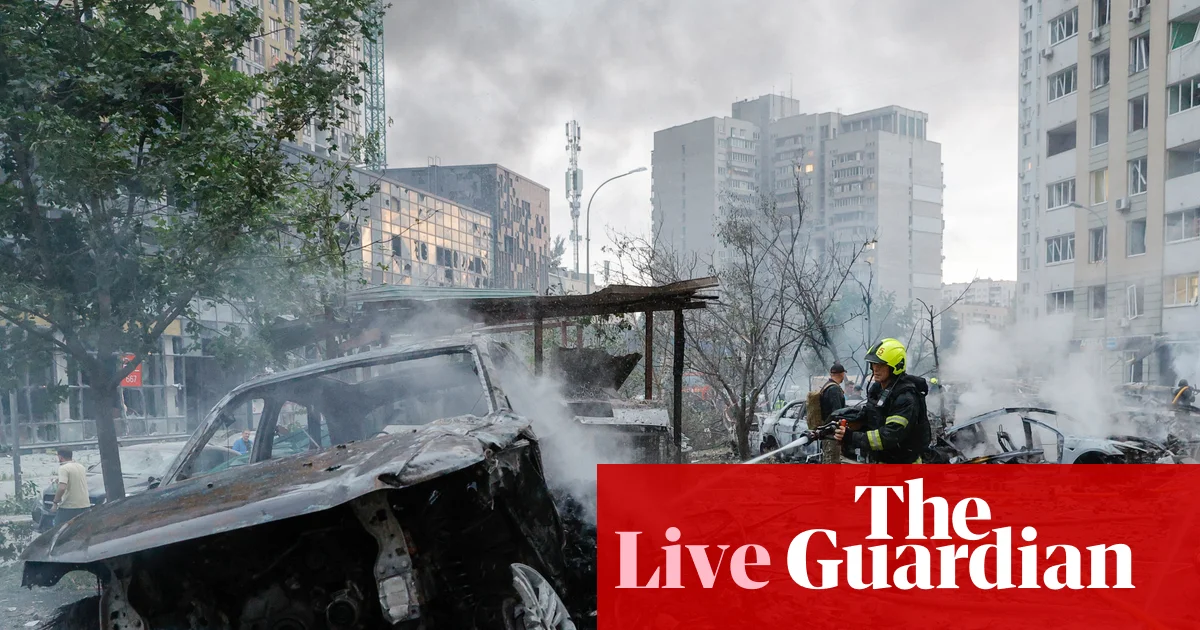
Death toll from attacks on Kyiv and wider region rises to 19
The death toll from last night’s Russian attacks on Kyiv and the surrounding region has risen to 19, with more than 70 people injured, AP said in the latest update.
Key events
Trump to meet Zelenskyy on sidelines of Nato summit this week
Back to Ukraine, the US president, Donald Trump, is expected to meet with Volodymyr Zelenskyy on the sidelines of the Nato summit in Ankara, Turkey, starting tomorrow, AP said.
Kyiv is trying to refocus Trump’s attention on the conflict with Moscow, AP added.
Trump is also expected to meet with Syria’s president Ahmad al-Sharaa.
Jon Henley
Europe correspondent
The Pyrenees fire has nearly tripled in size since Sunday.
“It came within 300 metres [984ft] of the houses. We were shocked by how fast it spread, it was staggering – bordering on panic,” Patrice, from the village of Trévillach, told Agence France-Presse.
The blazes follow a premature May heatwave and another in June that shattered temperature records across western Europe, caused thousands of excess deaths and left vast areas of land particularly vulnerable to wildfires.
The World Weather Attribution group of scientists has said the extreme temperatures recorded in June would have been “virtually impossible” without the climate crisis. Temperatures are forecast to climb again this week, rising to 40C locally.
Thousands flee homes across Europe as wildfires spread and temperatures rise again
Meahwile, thousands of people had to flee their homes across southern Europe as firefighers are battling blazes across Portugal, Spain, France, Greece and other countries.
AFP noted that the fires are spreading as temperatures rise again in a continent still scarred by the aftermath of heatwaves in May and June that have been blamed for thousands of deaths.
Some 10,500 people were told to evacuate their homes near Perpignan in southwestern France as firefighters battled a blaze in the Pyrenees that has devoured more than 4,600 hectares, authorities said.
Authorities said Monday’s third stage of the Tour de France cycle race through the Pyrenees would take place without the thousands of spectators who normally line the route.
Meanwhile in Greece, flames set off by a forest fire tore through two factories in Thessaloniki in the north of the country, forcing authorities to evacuate the surrounding area and to warn households to keep their windows closed, AFP reported.
A fire that threatened the tourist beaches of the Costa Brava in northeastern Spain burned more than 2,200 hectares in two days and was still being fought Monday, with other wildfires reported across the country.
In Portugal, emergency services said they had controlled a wildfire that devastated some 13,000 hectares of forest and scrub land in a northern district.
Ukrainian drones strike deep into Russia, in western Siberia
The governor of Russia’s Omsk region has said that the western Siberian province had come under attack from Ukrainian drones, in what would be one of the longest-ranged Ukrainian strikes since the beginning of the war.
In a post on Telegram, reported by Reuters, Vitaly Khotsenko said that several drones had reached what he called “Omsk’s northern industrial hub”, which is located around 2,700 km (1,700 miles) from Ukrainian-held territory, close to Russia’s border with Kazakhstan.
He said that the consequences of the attack were being clarified, and that emergency services were working to “liquidate” the strike’s aftermath.
Khotsenko gave no information on what had been targeted, but Omsk’s northern outskirts play host to Gazpromneft’s Omsk refinery, Russia’s largest.
UK sanctions Russian actors involved in novichok and Epibatidine research, development, production
Meanwhile, the UK has just sanctioned Russian actors involved in researching, developing and producing the novichok nerve agent and the lethal toxic Epibatidine, used in the Salisbury attack and the poisoning of Alexei Navalny.
Among those sanctions are SC Signal, a Russian state scientific research institute, as well as three individuals researching novichok and Epibatidine.
The announcement comes just before the Nato summit in Turkey, with the UK saying it will join allies “in strengthening collective security to tackle the long-term threat posed by an increasingly reckless and dangerous Russia, its egregious and irresponsible action.”
UK foreign secretary Yvette Cooper said:
“Russia’s repeated use of chemical weapons is a sickening violation of international law and a direct threat to global security.
From the use of novichok nerve agents in Salisbury to Epibatidine in Siberia, poisoning Dawn Sturgess and Alexei Navalny, Russia continues to use barbaric tools to inflict death and suffering on innocent civilians, including in Ukraine.
We will continue to call out Russia’s violations of the Chemical Weapons Convention, hold those responsible to account, and work with allies to deter further use of these dangerous weapons.”
Kremlin says Trump’s position on Ukraine ‘consistent’ throughout the war
Meanwhile, the Kremlin said on Monday that US president Donald Trump has had a pretty consistent position on the conflict in Ukraine and that suggestions that Trump frequently changed his mind on the subject were not true, Reuters reported.
Trump spoke with Russian president Vladimir Putin for nearly 90 minutes by phone on Saturday ahead of this week’s Nato summit in Turkey. Trump also spoke to Ukrainian president Volodymyr Zelenskyy.
Ukraine hopes to sign ‘drone deals’ with seven Nato countries by end of year

Shaun Walker
in Kyiv
Back to Ukraine, the country hopes to sign major defence deals with at least seven Nato countries by the end of the year, according to a top official, highlighting a new aspect of Kyiv’s foreign policy intended to show it can be a provider as well as a recipient of military hardware and expertise.
Kyiv has signed “drone deals” with six countries in recent months. Three are Middle Eastern states, who became eager for Ukrainian support after being targeted with Iranian long-range Shahed drones after the US-Israeli war on Iran began in spring.
These are the same weapons that have targeted Ukrainian cities relentlessly over the past four years. Azerbaijan has also signed an agreement with Kyiv, as well as the Nato members Latvia and Lithuania.
“The initiative is called the drone deal, but it actually covers way more than just drones … what’s even more important is the experience and knowledge, the access to all the components that form the system here in Ukraine,” said Davyd Aloian, the deputy secretary of Ukraine’s security council and one of those in charge of the deals.
The drone diplomacy began during Trump’s war on Iran, when Tehran attacked US allies across the region.
Most of the Gulf countries turned out to be unprepared for the threat from drones, even though Iran was mostly using a much less sophisticated version of the Shahed than the upgraded models that Russia uses in Ukraine.
Hungary posted spies to Brussels under Orbán, EU investigation confirms

Jennifer Rankin
in Brussels
In other news, an official EU investigation has found that Hungarian intelligence posted spies to Brussels under the previous government led by Viktor Orbán, but stopped short of attributing responsibility.
In a letter to MEPs the European commissioner for budget and public administration, Piotr Serafin, said that Hungarian intelligence had posted several officers to Hungary’s diplomatic outpost in Brussels between 2013-16, where they used their position for “a specific mission that appears to have gone beyond the tasks” usually associated with diplomats.
The letter, seen by the Guardian, is dated 27 April 2026 and states that the activities of the intelligence officers were “initially discreet but gradually became much more overt from 2015 onwards” which ultimately hampered their efforts. The commission believes such activities stopped in 2016 and did not cause any serious security breach.
The letter was first reported by Politico.
The spying covers a period when Hungary’s permanent representation to the EU was led by Hungary’s serving EU commissioner, Olivér Várhelyi. Várhelyi was Hungary’s EU ambassador, or permanent representative, from 2015-19, having served as deputy from 2011-15.
He has always denied any knowledge of the spying at the organisation he used to run.
The letter does not refer to Várhelyi, but nonetheless raises awkward questions about his oversight at the perm rep. In his letter Serafin said it had not been possible to attribute individual responsbility or involvement beyond the intelligence officers themselves.
Varhelyi was appointed by Orbán in 2019 to serve as Hungary’s EU commissioner and is expected to remain in post until the end of his mandate in 2029.
The espionage charges emerged last year, when the Hungarian investigative outlet Direkt36, working with Belgian and German media, reported that Hungarian intelligence began attempting to spy on the commission more than a decade ago, with efforts to recruit officials and get them to hand over classified documents.
Every EU member state has a permanent representation in Brussels focused on EU decision making, but using these outposts as a base to spy on the EU institutions is seen as unprecedented.
Ukraine strikes oil refineries in Russia
Meanwhile, Ukraine’s military said on Monday it struck oil refineries in Russia’s Yaroslavl and Leningrad regions overnight.
Explosions were recorded near the Slavneft-YANOS oil refinery in Yaroslavl region, and smoke was seen rising from the premises, the Ukrainian military’s General Staff said on Telegram, as reported by Reuters.
Death toll from overnight strikes rise to 14; 117 injured

Tess McClure
in Kyiv
A wave of Russian missiles and drones has struck Kyiv on the eve of a Nato summit in Turkey, killing more than a dozen people and heavily damaging apartment blocks and other buildings.
“In total, 14 people have died and 117 have been injured in Kyiv,” the office of the attorney general said on Monday morning.
Tymur Tkachenko, the head of the Kyiv region’s military administration, said:
“Sadly, this is not the final toll. Rescue operations are still ongoing.”
Dozens of people were hospitalised, including several children, he added.
The Russian Defence Ministry confirmed it used long-range weapons and drones to carry out a “massive” attack on Kyiv and other locations. In a Telegram post, the ministry said it had hit military and energy facilities in Kyiv and the surrounding area, as well as military airfields in several other regions.
Overnight attack on Kyiv – in pictures
‘Decisions on air defence are needed now, not later,’ Ukraine’s foreign minister says
Ukraine’s foreign minister Andrii Sybiha urged Nato leaders to “protect Ukrainian children from Russian ballistic terror,” saying “there is no more urgent task,” and warning them that “all decisions on air defence are needed now, not later.”
“As world leaders head to Ankara, I would like them to hear what families in Kyiv heard this night. One of the most brutal attacks using dozens of ballistic missiles. A terrifying barrage of loud explosions, one after another. Russian terrorists struck at sleeping civilians, hitting residential high-rise buildings to inflict as much damage as possible,” he said in a post on Telegram.
He said it was up for Nato to respond to Putin’s brazen attacks on Kyiv. “The time for weak steps has passed; this will only encourage Moscow to continue and spread terror beyond Ukraine,” he warned.
Ukraine urgently needs more air defence, EU’s von der Leyen says, pledges to discuss at Nato
European Commission president Ursula von der Leyen backed Zelenskyy’s call for stronger air defence for Europe, saying this will be discussed at the Nato summit in Ankara this week and pledging that Europe will “keep increasing the pressure until Russia ends the bloodshed.”
In a post on X, she said:
“Last night, the Russian regime once again blindly attacked civilians from the air, with over 400 drones and missiles attacking the capital. Ukraine urgently needs more air defence. We will discuss it this week in Ankara at the @NATO Summit.
Last week we provided the first €4 billion under our €90 billion loan, to strengthen Ukraine’s defence with advanced drone technology. More is coming very soon. And we are working hard to seal the deal on the 21st sanctions package in the next days. We will keep increasing the pressure until Russia ends the bloodshed.”
Morning opening: Zelenskyy calls for ‘strong decisions’ after Russia kills 11 in strikes on Kyiv

Jakub Krupa
Ukraine’s president Volodymyr Zelenskyy has urged Nato to make “strong decisions” at this week’s Nato summit in Ankara after 11 people were killed in another overnight Russian strike on Kyiv.
Around 60 more people were injured after 68 missiles and over 350 drones hit the Ukrainian capital.
He said Ukraine struggles because of “the insufficient supply of interceptor missiles,” and its partners could help to supply its air defence systems and “protect the lives of ordinary people.”
“As long as Patriot missiles remain in our allies’ stockpiles, Russia is only encouraged to keep vanquishing residential buildings. The United States and Europe have enough strength to stop this terror,” he said in a post on X.
The attack comes just days after a similar deadly strike on Kyiv, and with the Nato summit – expected to include discussions on Ukraine – starting tomorrow.
Russia claimed its “massive attack” targeted military and energy facilities, despite evidence showing damaged apartment blocks.
We are likely to hear more on this throughout the day, as leaders prepare for the Nato summit.
I will bring you all the latest.
It’s Monday, 6 July 2026, it’s Jakub Krupa here, and this is Europe Live.
Good morning.
