

Unlock the Editor’s Digest for free
Roula Khalaf, Editor of the FT, selects her favourite stories in this weekly newsletter.
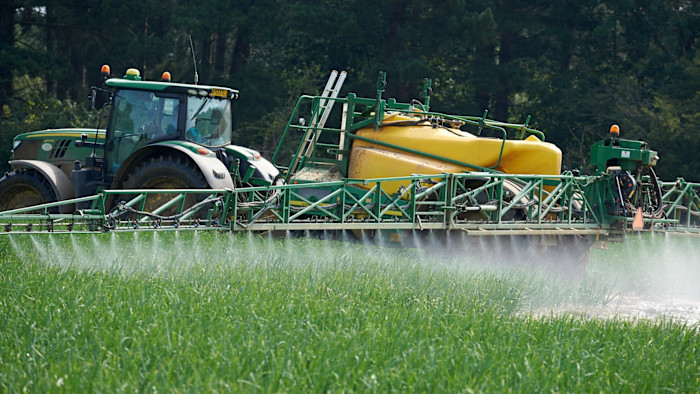
Heatwaves and volatile input costs are forcing farmers to cut pesticide use, switch their crops and plant trees to shade livestock as the sector tries to build resilience to hotter weather.
Another summer of record-high temperatures in England is accelerating the take-up of regenerative farming, a method that helps restore soil quality by cutting out chemicals and intensive ploughing, making it better at retaining water during hot spells.
Research by Barclays, published this week, found that more than half of the farmers surveyed this year had adopted regenerative practices, with nearly two-thirds of the 233 farmers saying they were reducing their pesticide or herbicide use.
“Farmers are panicking about what to do . . . But those that started regenerative farming 10 to 15 years ago are in a more resilient place,” said Martin Lines, chief executive of the Nature Friendly Farming Network.
The acceleration was both climate change-driven and a commercial imperative, the Barclays report found. Agricultural input prices have increased by 6.7 per cent in the 12 months to April 2026, significantly ahead of inflation, according to official statistics.
Fertiliser prices are not as high as they were at the beginning of the war in Iran and closure of the Strait of Hormuz, giving farmers some breathing room. The price rise provoked fears that arable production would fall significantly next year as farmers opted out of planting.
“Much of that concern has dissipated,” said Michael Haverty, partner at the Anderson’s Centre farm consultancy. “Fertiliser prices have not risen by as much as initially feared. As things stand, it gives time for supply to recover ahead of the next major applications of fertiliser in the spring.”
Agricultural consultants are advising farmers on how to plan for future droughts and volatile weather, but say there is little they can do in the short term.
Sheep and cattle farmers could move feeding times to later in the day, when temperatures are cooler and animals are more willing to eat, and refrain from handling and transporting livestock in the middle of the day to reduce stress, Haverty said.
Lines said he had seen farmers building additional sheds to shelter livestock from the sun. “Building more sheds to put animals in is nuts if we’re going to see over 30 degree temperatures,” Lines said. “Unless you’re going to add air conditioning.”
Longer term, farmers are advised to plant hedgerows and trees that provide shade for animals while also supporting biodiversity.
“The best time to plant a tree was yesterday,” said Holly Purdey, an organic livestock farmer in Somerset.
Nine years ago Purdey started planting hedgerows and trees to create natural shade for her sheep and cows. She also created natural water storage and flood management by digging ponds and trenches.
“Sometimes [farmers] only act when it goes into a point of an emergency, because on farms, we’re often firefighting,” said Purdey.
This year’s arable harvest is projected to be better than last year, which was one of the worst harvests ever recorded. Despite a very dry April and May, late rainfall in May provided some relief for crops, according to the Agriculture and Horticulture Development Board, a farmer-funded advisory group.
While yield outcomes for the harvest will depend on the severity of the heatwaves this summer, AHDB analyst Helen Plant said there was “reason for cautious optimism”.
The take-up of regenerative agriculture has been aided by the UK’s post-Brexit agricultural support schemes, which pay farmers to adopt sustainable farming practices and restore the natural environment.
Lines of the NFFN said the scheme should in theory successfully accelerate a transition to environmentally friendly farming, but that the former Conservative government had failed to ensure funds were fairly distributed. Last year, 4 per cent of England’s farms were receiving 25 per cent of the available funds, according to Defra.
The Labour government has since redesigned it to ensure smaller farms that were not yet enrolled in the schemes could also access it, opening it for applications in September this year.
“Farmers always follow the money,” Lines added.
