

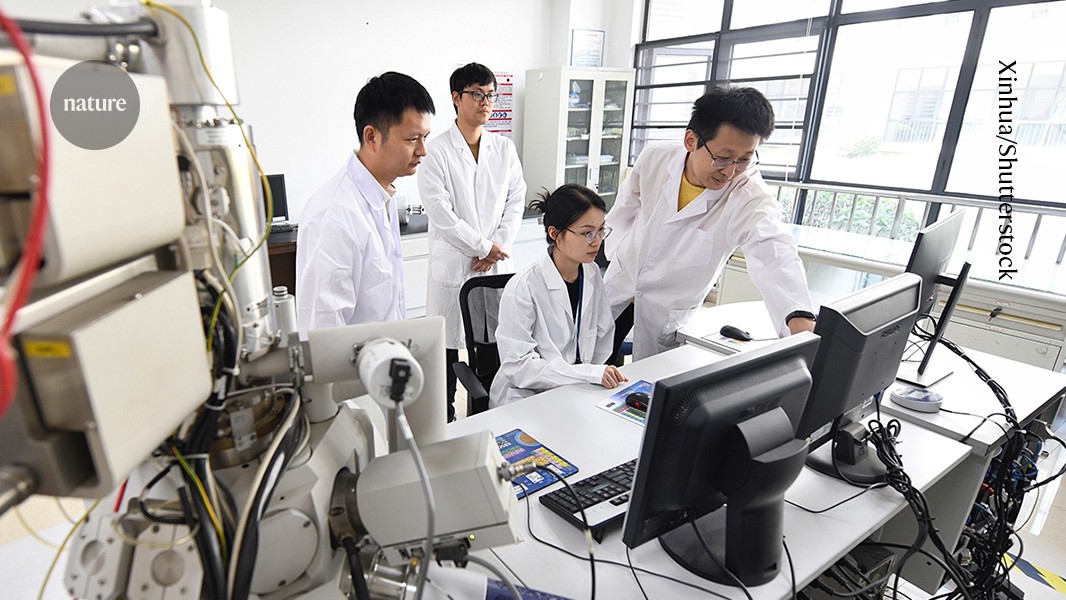
Early-career scientists in China face intense competition for entry-level jobs. Credit: Xinhua/Shutterstock
China’s main research funding agency will increase its number of prestigious grants for early-career scientists by 50%. The move is part of the country’s promise to step up support for young scientists, who face intense competition to secure funding and jobs. Early-career researchers have welcomed the news, but some academics say it won’t be a silver bullet.
The National Natural Science Foundation of China (NSFC), the country’s main funder of fundamental research, intends to finance an extra 12,000 projects this year through its Young Scientists Fund, equivalent to a budget boost of around 3.6 billion yuan (US$531 million). Projects are typically proposed by individuals, rather than groups.
“I was thrilled when I heard the news because more of us will be able to get grants,” says Shi, a 27-year-old postdoctoral student of electronic science and technology in Hefei, China, who has applied for a grant this year. He asked to share only by his surname to protect his identity.
In a statement published in May, the NSFC said that it would provide the extra sponsorships through one of the fund’s grant programmes, called C category, a highly competitive programme that is widely regarded as an entry ticket to the country’s research system. Last year, the NSFC handed out a total of 7.2 billion yuan to 24,051 selected projects through this category.

Can China keep up its extraordinary research growth?
“In many Chinese universities, early-career academics must win a grant under the NSFC’s Young Scientists Fund to find a job, get a promotion or secure tenure,” says Tong Xinzhao, a bioinformatician at the Xi’an Jiaotong–Liverpool University in Suzhou, China. Tong won a C-category grant last year after missing out four times.
Most early-career researchers apply for the C category because it is considered to be the most realistic route to obtain funding, Tong says.
C-category grants are open to postdoctoral candidates, junior researchers and some graduate students. Applicants must be under 35 years old if they are male, or 40 years old if they are female.
The agency is expected to announce who secured this year’s grants in August.
Boosting basic research
The fact that the Chinese government intends to expand the Young Scientists Fund by such a big margin is notable, says Li Jiang, an information scientist at Nanjing University in China, who has studied the challenges that young Chinese researchers face.
Competition for all funds managed by the NSFC has been fierce over the past few years owing to the surging number of applicants — despite the government continuously increasing the agency’s budget. For the C category, which was simply known as the Young Scientists Fund before 2025, its funding more than doubled between 2015 and 2025, but the success rate for applicants being awarded funding dropped from 24.58% to 14.38%, according to official numbers.
The boost to the Young Scientists Fund directly addresses the relentless competition these young people face by providing them with real and substantial resources, Jiang Li adds.
The news also sends a clear signal that the government considers young researchers as central to its plan of producing more discoveries in foundational sciences, says Li Jizhen, an innovation policy researcher at Tsinghua University in Beijing. In April, China’s President Xi Jinping directed the country to strengthen basic research.
Fierce competition
Many young researchers say that a big problem they face is their ‘up or out’ contracts at universities; these typically last for six years, after which researchers need to obtain tenure or otherwise face dismissal. This, plus the age restrictions for the Young Scientists Fund, makes the competition for grants particularly brutal.
“If you think about how old a student usually is when they finish a PhD programme, they don’t have many years left to try for this grant in order to set up a career,” says Tong. Some candidates need to balance grant applications with their plans to have children, she adds.

‘Student Geng’ ignites research-integrity scandal in China after calling out senior academics
