

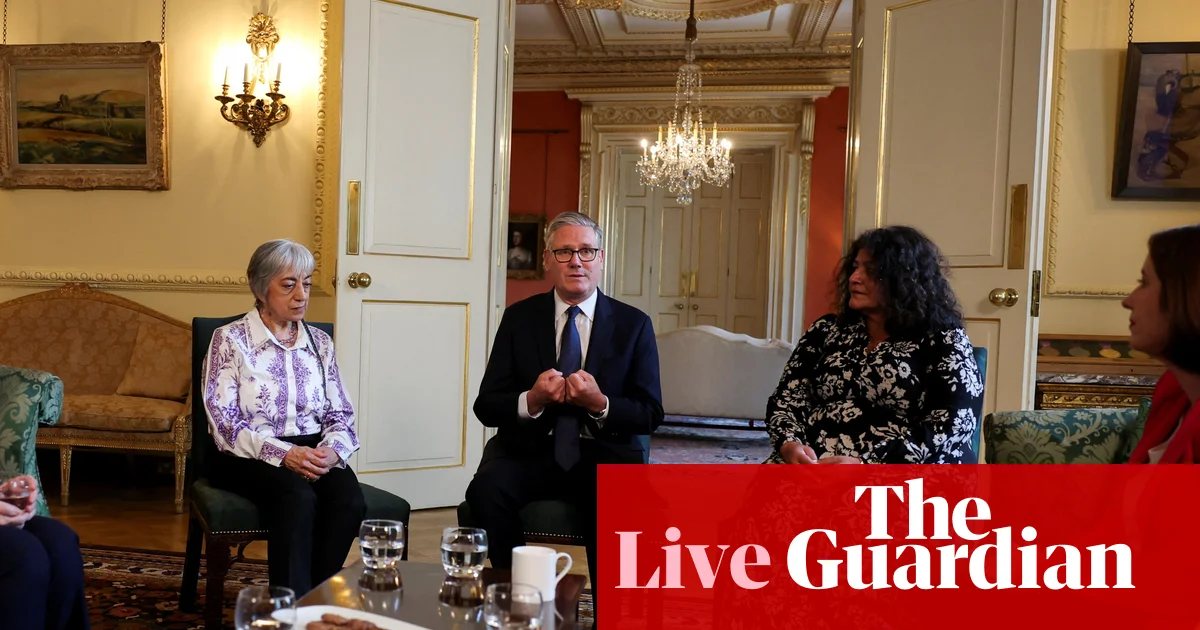
Starmer says forced adoption is ‘a stain on our history’
Starmer said what happened to the mothers, and their children, should never have happened. He said:
What happened to them, and to tens of thousands of mothers, children, and families, should never have happened. It is a stain on our history.
Mothers, many young, vulnerable, and without support were coerced, bullied, or misled into feeling that they had no choice but to have their children taken away from them. What a thing to do.
These were not isolated or accidental acts, they were practices embedded within systems across local authorities, across voluntary and faith-based institutions, and in health and social care services, including parts of what is now the NHS.
All institutions that operated with power over people’s lives, yet they did so without compassion, without consent, and without dignity or proper safeguards. These practices were particularly prevalent between 1949 and 1976 but also extended beyond those years.
Key events
Government encourages councils to let pubs stay open very late for England-Mexico World Cup match at 1am on Monday
Councils will decide whether pubs can stay open even later for the next England match that kicks off at 1am on Monday, the Press Association reports. PA says:
But local government secretary Steve Reed has urged them to sign off on pubs extending their hours to allow fans to watch to the end of the match.
England will face Mexico next in the Round of 16 at the Fifa World Cup after beating the Democratic Republic of the Congo 2-1 on Wednesday.
Monday’s match is not covered by measures to extend pub hours for England matches until 2am, and would run past that time anyway.
The Lib Dems earlier called for a blanket extension for licensing hours, but No 10 said “it is for local councils to make those decisions”.
A No 10 spokesperson said: “The secretary of state for housing and communities has written to councils to encourage them to sign off applications for pubs to extend their hours even further for these late games so that fans can enjoy the football.”
In a video posted to X, Reed said: “There are still some councils that are saying no to the pubs, and my message to those councils is please say yes, do everything you can to get those doors open and the fans inside and I will back you all the way.”
Labour was not prepared to govern in 2024, says Morgan McSweeney
Morgan McSweeney, the prime minister’s former chief of staff, has said Labour was not prepared enough for government or for the volatile world when Keir Starmer was first elected. Jessica Elgot has the story.
Andy Burnham, the new Makerfield MP set to become PM on Monday 20 July, has met the leaders of the 11 unions affiliated to Labour, the BBC is reporting.
Mahmood sets up taskforce on non-terrorist extreme violence as she accepts all Southport inquiry recommendations
Shabana Mahmood, the home secretary, has said she has set up a taskforce to improve the government’s response to the threat posed by non-terrorist extreme violence.
She described the taskforce, which will focus on early intervention, as she published the government’s response to the phase 1 report from the inquiry into the killing of three young girls by Axel Rudakubana at a dance class in Southport. Another 26 children were either stabbed (10) or traumatised (16) in the attack.
Sir Adrian Fulford, who is leading the inquiry, made 67 recommendations in his phase 1 report, which focused on the attack. He is now working on his phase 2 report, which will focus on the wider issue of how to respond to the threat posed by violence fixated individuals (VFIs).
Mahmood said she was accepting Fulford phase 1 report recommendations for central government in full.
In her foreword to the government’s response, she said:
We have already taken action to strengthen our response in several areas, including Prevent, online safety and knife crime. These are important steps – and they will make a difference. But we know we must go further.
That includes facing up to the reality that the perpetrator of this horrendous crime is not unique. Across this country, we face a threat from individuals who, while not driven by any clear ideology, are intent on conducting acts of extreme violence. Often, they are influenced by material and communities they encounter in dark corners of the online world.
We must do more to understand this threat and adapt our response accordingly. That is why phase 2 of the inquiry will examine the adequacy of arrangements for managing the risk from violence fixated individuals, how the online environment influences their behaviour, and whether we need to go even further to prevent access to knives and dangerous weapons
While the findings of phase 2 of the inquiry will undoubtedly present important recommendations for government, we will not wait to make further progress. I have established a new taskforce to strengthen government’s approach to non-ideological extreme violence, with a focus on early intervention, the online environment and our operational response. The taskforce’s work will run alongside that of the inquiry, so that we can move swiftly after phase 2 reports. The king’s speech also confirmed that we will legislate to close a clear gap in the current law by criminalising the planning of a mass casualty attack.
The latest episode of the Guardian’s Politics Weekly UK podcast is out. It features Kiran Stacey and Jessica Elgot talking about how Andy Burnham has been left to find almost £5bn to help fund the defence investment plan.
Starmer asks home secretary to consider options for removing Rochdale grooming gang leader
Keir Starmer has asked Shabana Mahmood, the home secretary, to review the case of a Rochdale grooming gang ringleader amid calls for the law to be changed to allow him to be deported. (See 9.39am.)
In a statement, Downing Street said:
We are absolutely clear that where foreign nationals commit offences in the UK, we will do everything in our power to remove them.
This is a particularly heinous case, and the prime minister has asked the home secretary to consider what can be done to remove this individual from the UK.
As Rajeev Syal and Josh Halliday report, the release of Shabir Ahmed is “really scary” for women and girls because of failings in a “weak” probation service, a whistleblower who exposed the paedophile ring has said. Here is their story.
In the Commons, the Labour MP Tracy Gilbert held back tears as she spoke of her own experience of being adopted.
Gilbert, MP for Edinburgh North and Leith said:
As an adopted person born in 1972 I welcome today’s statement from the prime minister. I have no idea if my birth mother felt forced to have me adopted. I do know that prior to the birth she was in a Church of Scotland mother and baby home.
My adopted parents have since died, but I am sure they would not want to have adopted any child who had been forcibly removed from their mother. Does the prime minister agree with me that mothers should be supported by the state to look after her children and not forced to give them up?
Keir Starmer replied:
Things that are intensely personal and private, full of pain and grief, being said out loud in a chamber like this is really difficult. It’s hard for some of us to comprehend just how difficult that must be, and so I salute her courage and resilience, and all those that have spoken out.
To have to speak out about something which is so intensely difficult, over and over again, is incredibly, incredibly demanding, but the comfort I hope is not only that because of that you have been seen and heard, but that others will have the courage to speak out about what happened to them, and I thank her in that regard as well.
Reform UK’s Sarah Pochin tells MPs she only learned about brother given up for adoption after her mother died
In the Commons, the Reform UK MP Sarah Pochin revealed that only after her mother died did she learn that her mother had had a baby given up for adoption at birth.
She told MPs:
My own mother was pressurised into giving up a baby for adoption, and this was handled by the church. I only found out after her death – she carried her secret to her grave.
When I found out, I tried to find my sibling, but drew a blank. I had to pay privately to find him, and we’ve now been united.
Can the prime minister assure those affected that the new systems and resources will be given the funding they need to reunite families?
Pochin was close to tears as she ended her speech, and in his response Keir Starmer paid tribute to her “huge courage” in sharing her story. He went on:
The way [Pochin] described her mother taking the secret to her grave is very powerful and an example of the way in which some people simply feel they can’t talk about this and didn’t talk about this, and where they’ve passed will never now be able to talk about this, so she shows great courage in speaking on her mother’s behalf as well.
Starmer also said he was glad Pochin had been reunited with her brother.
The Adult Adoptee Movement, which represents adults who were brought up to think that their mothers had chosen voluntarily to give them away, has welcomed the PM’s apology. But it also says it will be judged by what happens next.
In a statement, it said:
This apology is for the adoptees who were taken at their most vulnerable and sent to strangers.
For those who lost their wider family, medical history, culture, language or nationality. For those who suffered abuse, neglect or racism in their adoptive homes; who grew up hearing they were from ‘bad blood’, should be ‘grateful’, or had been ‘saved’.
For those subjected to the brutal, systemic racism of the adoption system who were judged ‘less than’ because of race.
For those who, due to disability or medical conditions, were judged less worthy of love and care. For those who were deceived about their origins.
For those who live with the long-term physical and mental health consequences of adoption. For those who have died.
It marks a fundamental correction of the narrative on historic adoption practices. What happened to you was wrong.
The measure of this apology will not be the words spoken today, but the actions taken tomorrow.
Bridget Phillipson, the education secretary, has issued her own statement about forced adoption. She said:
The pain carried by mothers, adopted children and their families who suffered this appalling injustice is unimaginable.
They were cruelly denied irreplaceable moments, shared experiences and relationships which should have been theirs, and were made to feel ashamed.
Today, on behalf of the British state, we say with one voice: this was wrong, and we are sorry. An apology cannot undo what happened, but it can be the start of real change, alongside providing the practical action, care and support that people need.
The Movement for an Adoption Apology has described the PM’s apology as a “positive step”.
In a statement, it said:
We recognise and appreciate the invaluable spirit of co-operation that has developed with the Adult Adoptee Movement (AAM), who work tirelessly for the many thousands of adoptees affected.
Though this apology has come too late for a significant number of people, it is a positive step for the hundreds of thousands of mothers still living with loss, whose suffering has at last been acknowledged, and for the children who were taken – now adult adoptees – whose lifelong trauma has now been recognised.
Starmer does not commit to ‘redress’ for forced adoption victims, but says government looking to support them
Alex Burghart, the shadow Cabinet Office minister, responded to the PM on behalf of the Conservative party. He said forced adoption was “mercifully alien to us” today.
He said:
185,000 children grew up in Britain without their mothers because of bad decisions and fundamentally flawed beliefs that treated unmarried mothers with a shame and stigma that today is mercifully alien to us.
But those decisions and those beliefs have left a permanent mark on each and every one of those lives, on children separated from their mothers and on the mothers whose children were taken away.
As the prime minister said, this is a stain on our history.
Burghart asked Starmer if the government was considering setting up a redress scheme, as the education committee recommended in its report earlier this year.
In response, Starmer thanked Burghart for the tone of his speech, and said it was important those affected knew that the apology issued today was supported by the whole of the Commons.
On the point about redress, he said the government was looking at schemes and being guided by those affected as to what they thought was most appropriate.
In its report, the education committee said:
The government should formally and publicly recognise that the state played a central role in enabling and sustaining historical forced adoption practices. Acknowledging this responsibility is essential in order to correct the public record, address previous misrepresentations, reduce the burden of blame and shame felt by many mothers and adoptees and the feelings of abandonment and rejection felt by many adoptees, and lay the groundwork for a credible apology and meaningful redress for those affected.
Starmer says peer-led support groups for mothers and adopted adults affected by forced adoption to be set up
Starmer said the government would set up peer-led support groups for mothers and adopted adults affected by forced adoption, and introduce measures to make it easier for them to access their records.
He said:
We will fund the development of a national online resource, creating a single access point to locate records wherever they may be held across the country.
We will consult on requiring existing records to be retained for 100 years, so they will remain available a
And the education secretary is today writing to local authorities, regional adoption agencies, and voluntary adoption agencies, setting out the expectation that requests for records should be responded to swiftly and with compassion and consistency.
And we will expand access to funded intermediary services, with particular focus on pre-1976 cases, where access to support is currently most limited.
We will establish national virtual peer-led support groups for mothers and adopted adults to improve access to ongoing trauma-informed support across the country, and we will work with NHS England to ensure those affected are taken seriously when they seek help.
This includes new support for clinicians to better understand the impact of forced adoption and respond appropriately in their care. NHS England will also explore how those who wish to do so can have their experience of forced adoption appropriately recorded in their health record.
And finally, to further recognise those affected and ensure we learn the lessons of the past, we will commission a testimonials project to capture the stories of those with experience of historic forced adoption practices.
Starmer said children forced into adoption “suffered a further injustice” becauase they had to “fight for the basic human right to know their own story”.
He said they were treated as if “the information about their own lives did not belong to them.
He went on:
Debbie was told her birth mother’s life would be in danger if she tried to search for her.
Barriers were put in place at every twist and turn.
Records have, in some cases, been lost, altered, or not made fully accessible to those seeking answers, and the whole process is painfully slow, traumatic, and dehumanising all over again.
We do say sorry and we mean it, but sorry is not enough.
This must also be the start of real change, working with those affected and their families to improve access to records and to provide the care and support that people need.
Starmer says forced adoption was ‘systemic failure’, and state did not protect people from harm
Starmer said that the victims of forced adoption were let down by the state.
Governments funded, enabled and relied on systems that were not consistently or effectively overseen.
The state did not prevent harm from continuing.
The state bears responsibility for the systems it funded and legitimised, which enabled these practices to occur.
The state did not do enough to protect mothers, children, and families from harm, and for this systemic failure, I am truly sorry.
‘We are deeply and profoundly sorry’ – Starmer delivers apology over forced adoptions
Starmer told MPs about the experience of one victim, the former Labour MP Ann Keen (see 10.18am) who recalls being “stitched without anaesthetic” and being told: “You will remember the pain because you’ve been a bad girl.”
Starmer said the apology he was giving would not be able to completely lift the shame women were made to feel at the time.
But he hoped it would help a little, he said.
He went on:
There are many, many thousands of [people], including some who still have not been able to speak about what happened to them to this day, and I hope that this statement, this apology, perhaps gives some of them the confidence to speak about what happened to them, because it will help in a small way.
But I say this: the shame is not yours. The shame was never yours. The shame is ours. And I say that on behalf of the whole country; I say it to every single person impacted.
We are deeply and profoundly sorry to the mothers who were told they were unfit, who were prevented from caring for the children they desperately wanted to help and to keep, and who have carried this loss for decades.
To those who were not given the information they needed to provide informed consent, who face pressure or coercion, and who experience practices that were unethical.
To the sons and daughters, the children who are now adults, who, through pressure and coercion within these systems, were taken from their families, denied their identity, their history, and sometimes their safety.
To those who grew up believing that they were unwanted.
