

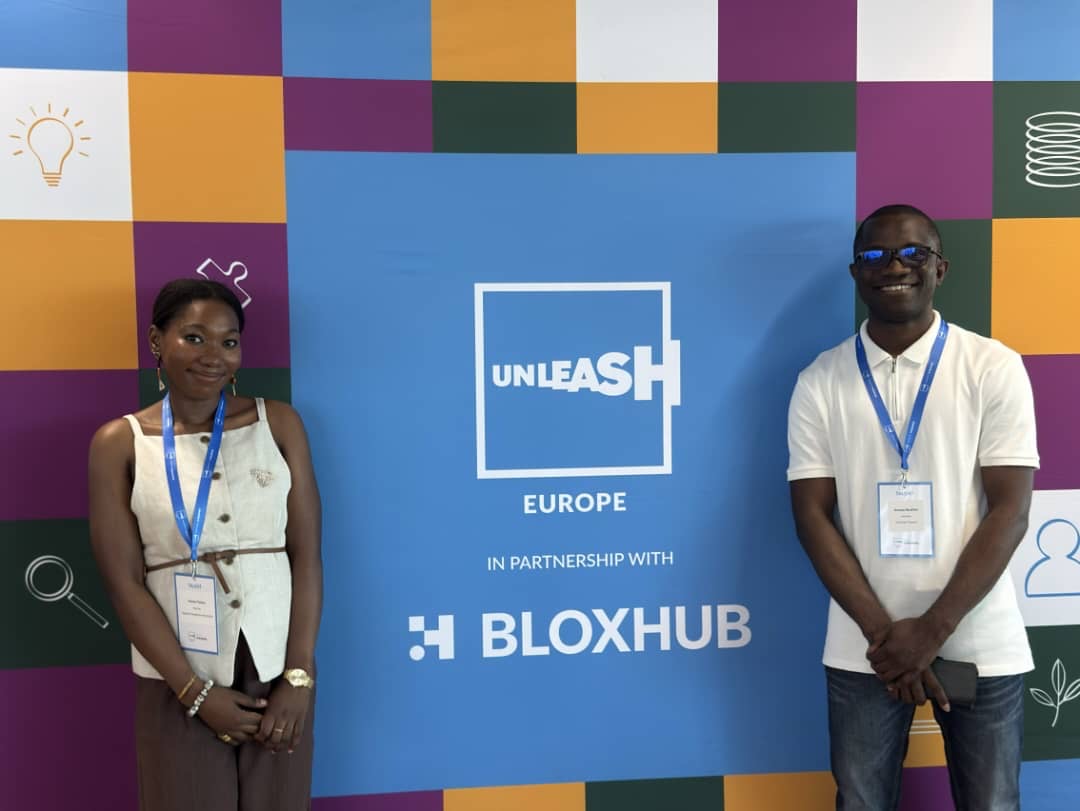
Europe-based doctoral researchers Arome Ibrahim and Hauwa Yunusa represented Nigeria at the prestigious UNLEASH Innovation Lab Europe 2026, a renowned event that fosters cutting-edge solutions to global challenges and connects exceptional young innovators from around the world.
Arome Ibrahim, a Marie Skłodowska-Curie Actions PhD Fellow at LUT University (Finland) and RMIT University (Australia), and Hauwa Yunusa, a PhD researcher in Future Ship Design for Decarbonization at KTH Royal Institute of Technology (Sweden), both of whom are alumni of the Erasmus Mundus Master’s programme, joined over 200 young changemakers from across Europe in Copenhagen, Denmark.
The week-long innovation lab convened outstanding young talent in multidisciplinary teams to co-design solutions that make European cities more circular, equitable, and livable, blending intensive collaboration, mentorship, and systems thinking to address society’s urgent urban challenges.
Arome Ibrahim holds an Erasmus Mundus Master’s in Impact Entrepreneurship (EMMIE). He is currently pursuing doctoral research on innovating for regenerative futures. His work examines how business models can go beyond harm reduction to actively repair and regenerate socio-ecological systems. Before academia, he founded an award-winning immersive technology company specializing in virtual and augmented reality, securing multiple grants and industry recognition.
Hauwa Yunusa, a marine engineer and advocate for women in the maritime industry, holds an Erasmus Mundus Joint Master’s Degree in Sustainable Ship and Shipping 4.0 (SEAS 4.0). She is also a PhD researcher at KTH Royal Institute of Technology, where her work sits at the cutting edge of maritime decarbonization. Her research aims to support the global transition to greener shipping by integrating Digital Twin technology into the ship design process, with a particular focus on wind-assisted propulsion.
The participation of both impact-driven researchers demonstrated the rising visibility of African talent in global science and innovation, underscoring the importance of drawing on diverse perspectives to address the world’s sustainability challenges and affirming that Africa’s next generation of researchers is not only keeping pace with the global conversation but also actively shaping it.
