

Unlock the Editor’s Digest for free
Roula Khalaf, Editor of the FT, selects her favourite stories in this weekly newsletter.
Ireland will ensure that metal from a Russian-owned alumina smelter does not “support the Russian war machine”, its prime minister promised after Ukrainian President Volodymyr Zelenskyy urged the EU to sanction the plant on a visit to Dublin.
Micheál Martin said an investigation into the involvement in weapons production of Aughinish Alumina, whose Russian owner, Rusal, was founded by sanctioned oligarch Oleg Deripaska, would conclude soon.
“We do not want to be in a position where material emanating from a plant in Ireland goes to support the Russian war machine,” Martin said on Wednesday. “We are coming to the end of an investigation so we get the full facts,” he said, adding he would discuss the results with the European Commission.
Dublin has shielded Aughinish from a “big push” by other EU countries to sanction it, according to an EU diplomat.
Martin’s remarks came in a joint press conference after bilateral talks on the issue with Zelenskyy, who said he wanted the investigation to conclude in less than a month.
“Every tonne of raw material that ends up in Russia is used against us in this war. We hope we won’t have to wait for a month,” he said.
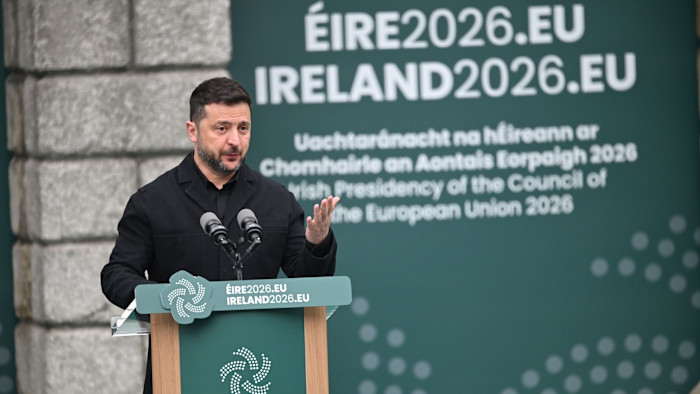
He had earlier applied pressure in a speech at the opening ceremony of Ireland’s six-month EU presidency at Dublin Castle in front of the Irish government and the president of the European Council, António Costa.
Thanking the EU for its help in the war, Zelenskyy added: “I urge you to continue this support through new European sanctions that are needed against Russia’s shadow fleet and against many of the tools [Russian President Vladimir Putin] can still rely on to keep this war going.
“This also includes companies in European countries whose only purpose is to work for Russia. Unfortunately, there are companies in Europe that are owned or effectively controlled by Russia and its sanctioned oligarchs. They keep supplying the aggressor with essential materials, even now,” he said.
Ireland is investigating how much of the alumina is exported to Russia from the County Limerick plant, which is Europe’s largest smelter of the raw material used to make aluminium. Neither Rusal nor Aughinish are currently subject to sanctions. Deripaska, however, is under sanctions from the US, EU and UK.
Russian customs records from 2025, reviewed by the FT, show that the largest recipient of the alumina is Rusal’s plant in Krasnoyarsk, a major aluminium production centre in Siberia.
Ireland’s enterprise minister Peter Burke last month cast doubt on data from the Irish national statistics office indicating that 83 per cent of Aughinish’s first-quarter exports went to Russia, saying the company had informed it that it had made a mistake. Rusal said the figure was 51 per cent, compared with 45 per cent in 2025.
But an EU diplomat said that even 51 per cent was still huge — especially at a time when Russia was conducting large-scale missile and drone attacks against Ukraine.
“We allow this alumina export to Russia, knowing that those missiles are produced with this alumina,” the diplomat added. “It is very cynical . . . for us, no amount is acceptable.”
Ireland’s government wants to advance Ukraine’s accession to the EU during its presidency after the formal opening of negotiations last month.
The smelter also exports to Sweden and to France.
“When we talk to Ireland privately, they say that sanctions would shut down the business. But if sanctions would shut down the business, it means that the volume that goes to Russia is huge,” the EU diplomat said.
Sanctioning Aughinish would come at a delicate time for Ireland, which will chair meetings of the EU under the revolving presidency until December.
Since Russia’s full-scale invasion of Ukraine in 2022, Ireland has considered nationalising Aughinish. It is not clear if it would take such a step now.
“What we shouldn’t do is have a knee-jerk reaction because there is pressure,” said one former minister with knowledge of past discussions, while acknowledging Aughinish was a “reputational issue” for Ireland.
“Once we have the facts, the government needs to look at the options,” said the former minister. “Does it nationalise Aughinish? Unlikely. But it’s a crisis option that we have looked at in the past in a shallow way.”
